
Move your home to Japan
Request a free estimate in under a minute.
Complete guide for expats relocating to Japan
Moving to Japan is mostly a paperwork game with a few hard deadlines. These are the five things worth knowing before you book a flight or a container.
Your used household things can enter free of duty and consumption tax if you're moving your home to Japan for a year or more. The catch is timing: you declare the boxes on the day you land, on Customs form C-5360, and the shipment has to clear customs within six months of the day you enter Japan.
Visa-free visits are for short stays only, up to 90 days. A long stay starts with a Certificate of Eligibility (free, usually one to three months), then a visa from the Japanese embassy or consulate in your country.
Once you land, the clocks start again. Register your address at the city office within 14 days, then sort out health insurance and the national pension, unless your employer enrols you.
A car, a pet or a medicine cabinet each come with their own rules, and some things (meat, soil, certain prescription drugs) are banned or need a permit. Tell us where you're leaving from and we'll send a free estimate for the move.
Japan is exact about paperwork. The rules aren't unfriendly, just specific, and a few of them run on clocks that start the day you land. The good news is that the rules that matter most come from Japan's own authorities, and we've linked each one so you can read it for yourself.
We've put this page in the order you'll meet things: what happens to your furniture and boxes at customs, the duty and tax question, the visa that lets you stay, your first two weeks of admin, then cars, pets, ports and the everyday stuff, from banking to driving to what the weather does to your plans. Rules change, so check the official page before you act on anything here. Where a figure changes every year, we say which year it is.
Leaving Australia, the UK or Canada? Each has its own page for the leaving end of the move: moving from Australia to Japan, moving from the UK to Japan, moving from Canada to Japan and moving from the USA to Japan.
How your move to Japan works
Three steps stand between you and your first night in Japan, and we take on the heavy parts of each one.
Tell us about your move
Where you're leaving from, which part of Japan you're headed to, and roughly what's coming with you. It takes about a minute, and a free estimate follows.
Meet your move buddy
One person looks after your move from the first question onward. They explain what Japan Customs expects, point out the steps only you can do (like the declaration at the airport) and plan the shipping around your dates.
Leave the shipping to us
We pack, ship and handle the customs paperwork on our side, then deliver to your new front door. You book the flight and decide which neighbourhood to explore first.
When to ship, and when to wait
Japan's busy periods follow its own calendar, not the Western holidays. If your dates are flexible, these are the windows to plan around:
- March and April
This is Japan's own moving season. The Ministry of Land, Infrastructure, Transport and Tourism says moving requests bunch up in March and April every year, and its February 2025 release put March at about double a normal month. Expect delivery crews and building access to be harder to book. Ministry release (Japanese) - Golden Week (29 April, then 3 to 5 May in 2027)
Government offices, customs included, are closed on public holidays in principle. If your clearance falls inside the block, it waits. Cabinet Office holiday list (Japanese) - 29 December to 3 January
Government offices are closed over the year-end break in principle, and Customs publishes reduced-service timetables for it. Nagoya Customs' notice for the 2025-26 break shows most of its offices on partial service or closed. Don't plan a clearance for those days. Nagoya Customs notice (Japanese) - July to October
Typhoon season. Across 1991-2020 the Japan Meteorological Agency counted 11.7 typhoons a year passing within 300 km of one of its stations, and August and September were the busiest months at 3.3 each. A shipment due in during those months deserves a few spare days in the schedule. JMA typhoon statistics
What happens to your belongings at Japanese customs
Good news first. If you're moving your home to Japan, your used household things can come in without duty or consumption tax. It's a statutory exemption rather than a favour, and it works if you do three things in the right order: declare, ship, clear.
Japan's Customs Tariff Law waives duty on used goods for the personal use of someone entering Japan to move their home there, and on the personal use of their family, plus the tools of their trade. The related consumption tax goes with it. Customs treats you as moving your home if your passport or other official papers show you'll stay in Japan for a year or more, or if you're coming back after living abroad for a year or more. (Customs' English pages say "more than one year" and its Japanese rules say "at least one year", so if you're close to the line, ask a Customs Counselor.)
The goods have to be things you and your family use, in a quantity that's reasonable for your circumstances. The Customs pages we read publish no item list and no box limit, and costly goods or anything that looks commercial may be handled like ordinary imported cargo. Cars and boats follow a separate exemption (see the car section).
- Japan · before you pack
Check what's banned or needs a permit
Some things are banned outright, and others need a permit, a certificate or a quarantine check before Customs will release them. The lists further down show what's on them. Do this before you pack, so nothing is held up later.
- Japan · on the day you arrive
Declare your shipped boxes at the airport
Customs form C-5360 (C-5360-B is the English copy) is titled "Declaration of Accompanied Articles and Unaccompanied Articles". Fill in two of them at the airport. Answer yes to question 3, the one about unaccompanied articles; a single form covers your whole family. The officer looks it over, stamps one copy with the Customs seal and returns it to you. Look after that stamped copy. It is the document you show when your boxes arrive, and Customs says it cannot replace it or run the step again. Visit Japan Web is Customs' preferred route for your hand luggage, yet its pages on separately shipped goods still talk about the paper form and the seal.
- Japan · within six months of arriving
Get the shipment cleared
Your clock is six months, counted from the day you enter Japan. Customs words it as the goods having to be clearable in that window, so aim to have the boxes released from the port well before it runs out, not merely docked. If something truly outside anyone's control gets in the way, such as a ship accident or a strike at the port, Customs may accept the delay, but it publishes no set extension. Shipping after you've landed is fine too, provided your arrival declaration is done and clearance still happens within those six months.
- Japan · at clearance
Show your papers and collect your things
When the shipping line or airline sends its arrival notice, collect the delivery order, then declare the goods at the unaccompanied-baggage section of Customs with your sealed form, the transport documents, a statement of contents, your passport and receipts. A licensed customs broker can do this for you if you give them the sealed form. Your boxes move to the inspection area (plants and animals go to quarantine first), you pay any tax assessed, and then you can collect them.
What to have in hand at clearance
Customs' own list for clearing unaccompanied baggage by sea or air is short:
- Your sealed declaration
The copy of form C-5360 that Customs stamped when you landed. Without it, your goods go through the ordinary import procedure used for trade cargo. If a customs broker clears for you, they need it before they start. - Transport documents
The delivery order you collect from the airline or shipping line once the arrival notice comes. - A statement of contents
A list of what's in the shipment. The pages we read give no template, so ask whoever packs for you for one. - Your passport and receipts
Both are on Customs' list. Keep the receipts for anything valuable. - A personal seal (inkan), if you clear in the Tokyo Customs district
Tokyo Customs' own checklist adds it. The national FAQ doesn't list one, so ask the office handling your clearance. - Permits and certificates
Anything the restricted list below calls for, such as a plant health certificate, shown when the item is inspected.
Plants, food and other things that get inspected
Some things go to a quarantine inspector before Customs will release them, and some can't come in at all. In short:
- Soil, and plants with soil
Both are banned. Other plants, seeds, seedlings and grain need a phytosanitary certificate from the country they leave and an inspection at the Plant Protection Station. Plants can travel with unaccompanied baggage: get the certificate abroad and have whoever clears your shipment present it at the inspection. Clean boots, bikes, tents and garden tools before they're packed. Plant Protection Station · its FAQ (Japanese) - Fresh fruit, vegetables and meat
Most fresh fruit and vegetables are banned, and meat and meat products (ham, sausage, jerky, even vacuum-packed or cooked, or anything with meat in it) are banned in principle, whatever the amount. The penalty can reach three years in prison or a fine of 3 million yen. Plant Protection Station (Japanese) - Other packaged food
Food for your own use doesn't need the Food Sanitation Act import notification, but Customs suggests you confirm with a Ministry of Health quarantine station first. Japan Customs: foodstuffs - Wooden crates and pallets
Japan regulates wood packaging in line with the ISPM 15 standard, which means heat treatment or fumigation and a mark. The MAFF page we read dates from 2009, so ask your mover what applies to your shipment. MAFF wood packaging FAQ - Medicines, vaping liquid and controlled drugs
Quantity limits and permits apply. The FAQ at the end of this page has the details. Japan Customs: medicines and cosmetics - Swords, guns, ivory and similar
Swords and hunting guns need a permit or registration plus approval from the Ministry of Economy, Trade and Industry; pistols, their parts and ammunition are prohibited outright. Ivory, crocodile leather and other protected-species goods need an export permit from the country they leave and an import licence from the same ministry. Japan Customs: firearms and swords · Japan Customs: endangered species
What you can import to Japan

Personal belongings
Duty and tax are waived when you move for a year or more, if the amount suits your household

Used clothing

Household appliances
Japan's mains is 100 V, so 220-240 V appliances need a step-up transformer

Fragile items

High-value items
Gold of any amount goes on your arrival declaration; cash over JPY 1 million needs its own form

Large items & furniture

Excess luggage
Tell Customs about it as unaccompanied baggage the day you land, and finish clearance inside 6 months

Pets
Tell the quarantine service 40 days ahead; most origins also need a rabies titre test and a 180-day wait, but not Australia or New Zealand

Vehicles
Duty relief needs form T-1280 and no selling for two years; driving it needs Japanese inspection and registration
What is banned or needs a permit in Japan

Illicit drugs & drug paraphernalia
Adderall (amphetamine) is refused even with a prescription

Prescription & non-prescription medicines
Up to a month of prescription medicine clears without a certificate; more needs one. Vyvanse needs approval beforehand, and you carry it yourself

Cannabis & CBD products
Cannabis can't be imported, and CBN products joined the banned list on 1 June 2026

E-cigarettes & vapes
Nicotine e-liquid is treated as a medicine; about a month's use (120 ml) clears without a certificate

Alcohol & tobacco
No published limit for movers (visitors get 3 bottles and 200 cigarettes), so ask Customs about a collection

Weapons, firearms & controlled items
No pistols or the ammunition made for them; hunting guns, air guns and swords are allowed only with permits

Explosives, fireworks & flares

Other hazardous or dangerous goods
Gas cylinders, kerosene and pesticides each fall under separate Japanese laws

Counterfeit & pirated goods

Banned publications & media
Anything obscene or immoral, plus child pornography

Ivory & protected wildlife products
Ivory and other protected-wildlife products need the exporting country's permit and a METI licence

Plants, seeds & anything in soil
No soil, and no plants with soil on them; other plants and seeds need a phytosanitary certificate

Food, supplements & consumables
Fresh fruit and vegetables are mostly refused at the border

Meat & dairy products
Meat is banned in principle, including ham, sausage and jerky
How much to bring, and what to leave behind
Japan sets no box limit, but it does set a test.
- The reasonableness test
Customs' pages publish no box count, weight limit or item list for household effects. The test is whether the goods are for your own and your family's use and reasonable for your circumstances. Costly goods and anything commercial may go through the same procedure as ordinary cargo. If you're bringing a lot, or something valuable, ask a Customs Counselor first.
- Our minimum is six boxes
Below that, a courier will probably serve you better. Above it, there's no upper limit on what we'll move.
- Power is different
Japan's mains is 100 V AC, at 50 Hz in the east and 60 Hz in the west (the line runs roughly along the Fuji River and the town of Itoigawa). A 220-240 V appliance needs a step-up transformer unless it's dual-voltage, and a 100-240 V charger needs only a plug adapter. Single-frequency appliances may not work on the other side of the line. Japan National Tourism Organization · Chubu Electric Power (Japanese)
Alcohol, tobacco and cash have their own rules. The duty and tax section below says what we found.
Official pages and forms
- Household effects for home relocation (Japan Customs FAQ 7301): who qualifies, the six-month window and the car rules, in English
- Declaring unaccompanied articles (Japan Customs FAQ 7103): the steps for the day you land and the day your boxes arrive
- Customs form C-5360 and Visit Japan Web: the form in English, French, Korean, Chinese, Spanish and more, ready to print
- Information for passengers (Japan Customs): allowances, cash and gold declarations, and restricted articles
Handy official contacts

Customs Counselors at your nearest Customs office answer questions about your own move
Duty and tax on your belongings
Japan can charge customs duty and consumption tax (its version of VAT) on imports, plus excise tax on alcohol and tobacco. For a genuine move, the relief in the section above covers your personal and household goods, so most people pay nothing at the port. Here is what's covered, what isn't, and where Customs hasn't given a number.
What the relief covers
- Covered
Used goods for the personal use of you and your family, and professional equipment, brought in under the relocation relief. Customs describes them as free of duty and/or tax. The consumption-tax law lists the same relief, and for this class of goods it extends to liquor tax and tobacco tax too. Japan Customs: passenger information · Act on Collection of Consumption Taxes on Imported Goods, Article 13 (Japanese) - Not covered
Cars, boats and aircraft (separate rules, see the car section), goods you're bringing to sell, and goods that aren't ordinary and reasonable for your circumstances. Customs may treat costly goods like general cargo. - When tax does apply
Import consumption tax is 10% (standard rate) or 8% (reduced rate) of the customs value plus duty plus any excise, according to the National Tax Agency page updated on 1 April 2026. Rates change, so check the current figure. National Tax Agency (Japanese)
Alcohol, tobacco, cash and gold
Customs publishes allowances for visitors and returning travellers: per adult, 3 bottles of alcohol (about 760 ml each), 200 cigarettes, 50 cigars or 250 g of other tobacco, 2 ounces of perfume, and other goods with an overseas value under 200,000 yen. Under-20s get no alcohol or tobacco allowance. Japan Customs: passenger information
Those numbers are written for travellers. The Customs pages we read don't say whether a mover's shipped goods follow them or the "reasonable quantity" test for household effects. If a wine collection or cartons of cigarettes are coming, ask a Customs Counselor before you ship. Above the allowances, Customs applies simplified duty-and-tax rates.
Cash, cheques, travellers cheques and securities worth more than 1,000,000 yen (or the equivalent) must be declared on a Declaration of Carrying of Means of Payment when you enter or leave. Gold in any amount, new or old, has its own tick-box on the arrival declaration. Rice has its own duty-free limit of 100 kg a year, and you file a Report for the Import of Rice with the Local Food Office.
Visas: the right to stay comes first
Start here, because everything else hangs on it. Japan doesn't have a "just move here" visa. A visa-free Temporary Visitor stay is granted for 90, 30 or 15 days, never more than 90, and covers tourism, visiting relatives, short courses and business contact. To live and work in Japan you need a status of residence. Immigration Services Agency: Temporary Visitor
The usual route runs through the Certificate of Eligibility (CoE). The person coming to Japan, the staff of the organisation taking them on, or another authorised agent files it with the Immigration Services Agency in Japan. It's free, it can be filed online and delivered by email, and the standard processing time is one to three months. Once issued, it's valid for three months. You then take it to a Japanese embassy or consulate in your country to apply for the visa itself, which the CoE speeds up. When you land, officers at ten airports can issue your residence card on the spot; anywhere else it follows by post. Immigration Services Agency: Certificate of Eligibility (Japanese)
The visa routes people ask about most
These are the routes we're asked about most, with the rules as published by Japan's Immigration Services Agency and Ministry of Foreign Affairs (checked 6 November 2026):
Short stays, visa-free
Up to 90 days as a Temporary Visitor for tourism, visiting family, short courses and business contact. Work for a Japanese employer isn't on the list of covered activities, and extensions are for truly unavoidable humanitarian reasons only.
Employee visas
Engineer/Specialist in Humanities/International Services suits skilled office, technical and international work under a contract with a Japanese organisation: a relevant degree or equivalent, or ten years' experience, and pay at least equal to a Japanese colleague's. Intra-company Transferee covers a fixed-period move from an overseas office of the same group. Stays of five years, three years, one year or three months are granted.
Business Manager (tightened in October 2025)
From 16 October 2025 the rules ask for five things. The business needs 30 million yen put into it. It needs at least one full-time employee, who must be Japanese or hold a settled or family-based residence status. You or a full-time employee must speak Japanese at roughly CEFR B2. A Japanese-licensed business consultant, accountant or tax accountant must have reviewed your business plan. And the office can't normally be your home. Existing holders have until 16 October 2028; after that, renewals are judged against the new criteria.
Highly Skilled, J-Skip and J-Find
Three routes for people with strong profiles. Highly Skilled Professional scores you on a points table, and 70 points qualifies. J-Skip is the fast track: it asks for a master's degree or ten years' experience plus 20 million yen a year, or five years in management plus 40 million yen, and leads to permanent residence after a single year. J-Find is for recent graduates of highly ranked universities, who get up to two years to look for a job or prepare a startup.
Digital nomad
Six months, no extension and no residence card. You need an annual income of at least 10 million yen and private medical cover of at least 10 million yen. You can work remotely for an employer or clients abroad, not for a Japanese organisation. Australia, Canada and the United Kingdom are on the eligible list, and a spouse or child gets their own six-month status.
Working holiday
For 18- to 30-year-olds from partner countries, including Australia, Canada and the UK (33 countries and regions as at 1 November 2026). You apply at the Japanese embassy or consulate in your own country, can't bring dependants, and may work only to top up your travel funds. Japan's foreign ministry gives 25 as the age limit for Australia and Canada unless the two governments extend it to 30, while the Japanese consulates in Sydney and Vancouver both say 30, so check your own embassy's page first.
Family (Dependent)
The spouse or child of someone on a work or study status, including Highly Skilled Professional, Business Manager, Engineer/Specialist, Intra-company Transferee and Student, can apply for Dependent status, granted for up to five years. Documents issued in Japan must be dated within three months, and foreign-language papers need a Japanese translation. The official page doesn't say whether a dependant may work, so ask Immigration before you plan around a second income.
Study
Student status is granted for a set period of up to four years and three months. The Immigration Services Agency's page doesn't cover part-time work, so ask its information centre (0570-013904, or 03-5796-7112 from abroad) before you plan on it.
Dates worth knowing: since 1 October 2026 the Immigration Services Agency charges more to extend or change a status of residence, and permanent residence went from 10,000 yen to 200,000 yen (as at November 2026). Applications for permanent residence filed from 1 April 2027 fall under a revised guideline, and visa-free visitors will eventually need JESTA, an electronic travel authorisation that the law says must start by 31 March 2029. Immigration Services Agency: fee changes (Japanese)
Rules change, and your case may differ. Check the current requirements with the Immigration Services Agency or the Japanese embassy or consulate for your country, and note that the agency warns anyone other than a lawyer or administrative scrivener (gyoseishoshi) who prepares application papers for a fee may be breaking the law. Moving with a partner? Our blog looks at the trailing spouse problem.
Official pages for each route (Japanese unless noted): Engineer/Specialist, Intra-company Transferee, Business Manager, Highly Skilled Professional, J-Skip, J-Find, digital nomad (English), Dependent, Student and working holiday (English).
Your first two weeks in Japan
The landing stamp isn't the finish line. Japanese admin runs on a few clocks, and the first one is 14 days.
- Collect your residence card.
If you land at Narita, Haneda, Chubu, Kansai, New Chitose, Sendai, Kobe, Hiroshima, Fukuoka or Naha airport, the card is issued as you land. Anywhere else, it comes later by post once your address is registered. Keep your passport or residence card on you whenever you go out; the police can ask to see it. - Register your address within 14 days.
Take your residence card (or your passport, if the card is coming later) to the municipal office for your new home. It's free. Filing the resident-register notice with your card or passport also counts as your notice to Immigration. If you move again, notify the new office within 14 days of moving in. - Watch for your My Number.
Foreign nationals with a resident record are assigned a My Number, and the notification comes by post. The My Number Card is a separate application. Since 14 June 2026 there's also a "specific residence card" that works as both cards; it's optional, you apply in person, and it can't be issued at the airport. - Join public health insurance.
Everyone who lives in Japan has to be in a public scheme. If your employer enrols you, you're covered through work. If not, enrol in National Health Insurance at your municipal office; foreign residents staying more than three months are required to. The usual patient share is 30%, and premiums depend on last year's income and your household. Immigration can take unpaid premiums into account when you renew your stay. - Join the National Pension (ages 20 to 59).
Employees are enrolled by their employer. If you're self-employed, a student or between jobs, register at your municipal office within 14 days. The monthly contribution is 17,920 yen for fiscal 2026 (April 2026 to March 2027) and is reset each April. If you leave Japan for good, non-Japanese nationals with enough paid months can claim a lump-sum withdrawal payment within two years of leaving, subject to conditions.
Official pages for this section: Immigration Services Agency: address notification (Japanese), Digital Agency: My Number FAQ, Ministry of Health, Labour and Welfare: public health insurance guide, Japan Pension Service: enrolling in the National Pension, Japan Pension Service: contributions, and for leavers, Japan Pension Service: lump-sum withdrawal payments.
Bringing your car
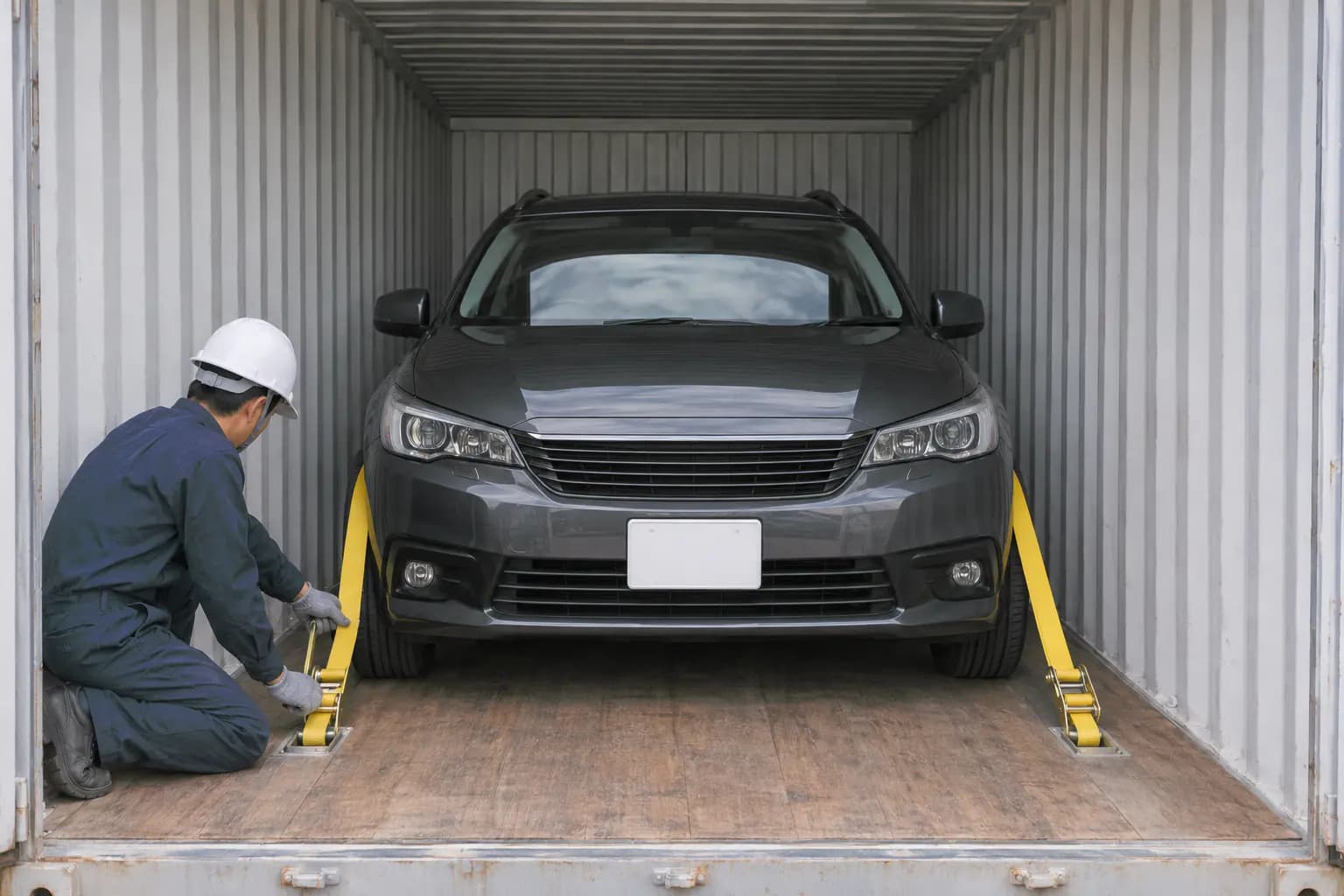
A car isn't part of the household-effects relief. Customs handles a vehicle you used before you moved under a separate duty exemption. The duty-free treatment comes with a condition: you can't sell the car or give it to someone else within two years of the import permit. Japan Customs FAQ 7301
What you need to bring a car
What you need to bring a car
- For Customs
File an ordinary import declaration, as for any cargo. With it go three copies of the form applying for duty exemption on household effects such as cars, something that shows the car has really been in use (a registration certificate works) and evidence that you are relocating to Japan. - On the road side
To drive on public roads, a vehicle needs safety-standards certification, inspection (shaken) and registration. For a car registered in Japan for the first time, the Ministry of Land, Infrastructure, Transport and Tourism lists documents such as the customs clearance certificate, an emissions-inspection certificate or the imported-vehicle special-handling notification, and a preliminary inspection certificate or a presented-vehicle inspection. Tohoku Transport Bureau (Japanese) - Ask before you ship
The official pages we read don't say whether a particular car will pass Japanese standards, and don't give a total cost. Check with a transport bureau office before you pay to ship it.
Bringing your dog or cat
Japan quarantines every dog and cat that enters, under its Rabies Prevention Act, and the paperwork you need depends on where your pet is coming from. The short version is below.

Your pet's checklist
- Plan months ahead
From Australia, New Zealand, Iceland, Fiji, Hawaii and Guam (Japan's designated regions), the track is simpler. From everywhere else, including the UK and Canada, a dog or cat needs a microchip, at least two rabies vaccinations, a rabies antibody blood test and a 180-day wait counted from the blood sample before it can arrive. Animal Quarantine Service: designated regions · other regions - Tell Japan at least 40 days ahead
You notify the Animal Quarantine Service at your port of entry online through NACCS, or by email form if that fails, and in principle a notification made less than 40 days before arrival is not accepted. - Dogs: only certain ports
Dogs can enter Japan only through designated airports and seaports. - At arrival
A pet that doesn't meet the requirements can be held in quarantine for up to 180 days, or refused entry. Animal Quarantine Service: dogs and cats
How your things get to Japan
Nine regional Customs offices share the country between them: Hakodate in the north, Tokyo and Yokohama around the capital, Nagoya, Osaka and Kobe in the middle, then Moji, Nagasaki and Okinawa towards the south-west. Whichever one covers the port or airport where your boxes land is the one that clears them, so your address in Japan really does decide where the shipment should arrive. Think of the list below as a map; the actual landing point is picked to suit your address and your load.
How long the sea leg takes depends on where you start and which sailing you're on, so we don't print a one-size table here. Ask for the actual sailing schedule when you get your estimate, and allow time at both ends for pick-up, export clearance and import clearance. Schedules shift week by week, and Japan's own busy periods are listed above.

Ports and airports you will hear about
Yokohama and Tokyo
The sea gateways for Tokyo and the Kanto plain around it. Each has its own Customs office.
Nagoya
The sea gateway for the Chubu region, with its own Customs office.
Osaka and Kobe
The pair that serves Kansai, the region around Osaka, Kyoto and Kobe.
Hakata
Fukuoka's port, serving Kyushu, and handled by Moji Customs.
Narita and Haneda
Tokyo's two international airports.
Kansai and Chubu airports
The international airports for Osaka and Nagoya.
Insuring the shipment
Duty relief says nothing about damage. Cargo insurance covers the physical risk of the trip, and the policy wording decides what's actually included, so read it before you sign.
What cargo cover usually leaves out
A standard "all risks" marine cargo policy (the Institute Cargo Clauses (A) are the usual wording) covers loss or damage except for listed exclusions, among them:
- Insufficient packing, when you or someone acting for you did the packing, or when it was done before the cover began (loading a container counts as packing)
- Inherent vice: things that fail or spoil by their own nature
- Delay, even when an insured event causes it
- War, strikes and terrorism, which are normally bought back as an extra
The clauses we read don't name earthquakes or typhoons either way, so ask your insurer how a storm or quake claim would be handled before you buy.
Getting cover
Cover can come from:
- A general insurer with a marine cargo policy
- A broker who specialises in relocation cover
- Your bank, if it sells shipment insurance
- Cover arranged alongside your move with us: ask your move buddy for the policy wording and the exclusions before you decide
Whoever you choose, declare what your things would cost to replace. The amount you declare usually sets the limit on any claim.
Door to door: from your old home to your new one
Door to door means your boxes are packed in your old home and delivered to your new one. Here's the short version of what happens in between:
- We pack.
Boxes in the right sizes, wrapping around glass and electronics, and wooden crates for artwork and anything that deserves extra armour. - We collect and track.
Everything is picked up from your door and logged, so you know where your things are. - We ship and handle customs.
By sea or air as agreed. The Japanese customs step needs the sealed declaration you receive at the airport, so your move buddy will tell you exactly what to hand over and when. - We deliver.
Once Customs releases the shipment, it goes to your new address.
One thing worth asking early: some buildings in Japan set their own rules for deliveries and lift use, so check with your landlord or building manager before the delivery date.
One person to ask, from first question to delivery
From your first question to the day your sofa arrives, you have one person to ask. No explaining your situation from scratch every time.
Your move buddy handles the coordination and the documents, and explains the customs questions as they come up. Because they know your plans, they can spot problems before they bite.
Questions? Just say hello
Life in Japan: what the official numbers say
Whether you'll love living in Japan is a matter of taste, and no statistic can settle it. What a statistic can do is stop you planning around a rumour. So this part sticks to figures from Japan's own agencies and names the source for each.
For anything that depends on your own circumstances, like tax, visas and insurance, an adviser who has seen your papers is the right person to ask. Planning beyond the first few months? Our blog looks at what changes in your second year abroad.
Three clocks to keep in mind
6 months
Time limit to clear your shipped goods through customs after you arrive
14 days
Time limit to register your address at the city office after you settle
1-3 months
Standard processing time for a Certificate of Eligibility, which is free
What a month costs, and what renting involves
Japan's Statistics Bureau puts average monthly consumption spending for two-or-more-person households at 314,001 yen in 2025, up 4.6% on the year before. Those households average 2.87 people with a head aged 60.7, and the survey includes homeowners, so it says nothing about what a newcomer pays in rent. Use it as background, not as a budget. Statistics Bureau: Family Income and Expenditure Survey
For renting, the Ministry of Land, Infrastructure, Transport and Tourism publishes an English Apartment Search Guidebook. It describes typical practice, not law: a guarantor or rental guarantee company is often required, a rule of thumb is 4 to 7 months' rent for move-in payments, the security deposit is around two months' rent, key money (usually one or two months, not returned) is often asked in the Kanto region, and the agency fee runs to up to one month's rent. Contracts normally run two years, and it can take one to two weeks from application to moving in. MLIT Apartment Search Guidebook (PDF)
Every city writes its own rubbish rules, so learn yours early. In Yokohama, burnable waste goes out in a see-through or semi-see-through bag, plastics, cans and bottles, paper and cloth are collected separately, and the city won't take air conditioners, TVs, refrigerators, washing machines, dryers or computers at all. Kyoto instead sells designated bags that you pay for. Your city office can give you the local guide. Yokohama City: sorting and disposal
Earthquakes, typhoons and staying safe
Japan sits on active fault lines and in a typhoon belt, and its government publishes the numbers. The Headquarters for Earthquake Research Promotion rates the chance of a Nankai Trough earthquake within 30 years at 60-90% or more (as at 1 January 2025) and asks people to plan around the higher figure. The Japan Meteorological Agency's 1991-2020 averages show about 11.7 typhoons a year approaching Japan. Earthquake Research Committee (Japanese) · JMA typhoon statistics
JMA's Earthquake Early Warning has run since 1 October 2007 and issues alerts through TV, radio and other media as a quake starts, giving seconds to protect yourself. For emergencies, call 110 for police (an interpreter can join if you don't speak Japanese) and 119 for fire, illness or injury. JMA: Earthquake Early Warning · Tokyo Metropolitan Police living guide
Tax on your income and savings
For income tax, you're a resident if you have a home in Japan or have lived there continuously for a year or more. A resident who isn't Japanese and has lived in Japan for five years or less in the last ten is a "non-permanent resident": taxed on Japanese income, and on foreign income that is paid in Japan or sent to Japan, but not on foreign income that is paid and left abroad. Everyone else who is resident is taxed on worldwide income. Japan's definition doesn't use a 183-day count, so don't plan around one. National Tax Agency: residency and taxable income (PDF)
Two thresholds worth knowing: residents who aren't non-permanent residents and hold foreign assets worth more than 50 million yen on 31 December must file a Foreign Assets Report by 30 June the next year, and an exit tax can apply on leaving if you hold at least 100 million yen of covered securities and have lived in Japan for more than five of the last ten years (years on work, student, dependent or short-stay statuses do not count towards the five). NTA: foreign assets FAQ (PDF, Japanese) · NTA: exit tax (Japanese)
Japan has income tax treaties with Australia (in force 2008), Canada (1987, protocol 2000) and the United Kingdom (2006, protocol 2014), and social security agreements with 24 countries as at December 2025. Australia and Canada have pension totalisation; the UK agreement covers contributions only. This is general information, so talk to a tax adviser who knows both countries before you move. US citizens have US filing questions of their own on top of Japan's, and our blog covers two common ones: who has to file an FBAR and the foreign earned income exclusion and Form 2555. Ministry of Finance: tax conventions · Japan Pension Service: agreements
Work and the language question
Japanese immigration rules set a language bar in only a few places. Business Manager needs about CEFR B2 Japanese, from the applicant or a full-time employee. From 15 April 2026, Engineer/Specialist applicants in employer categories 3 and 4 whose work mainly uses language skills must show B2-level ability in the language they use at work. The revised permanent-residence guideline asks for about B1. The Engineer/Specialist landing criteria themselves set no Japanese test. Immigration Services Agency: Engineer/Specialist (Japanese)
Looking for work once you're there? Job-seekers from abroad can get help in English or other languages at the Employment Service Centres for Foreigners in Tokyo, Nagoya, Osaka and Fukuoka, and at some Hello Work offices, according to Japan's foreign ministry. Ministry of Foreign Affairs: working holiday page
Schools and where to get help
The Ministry of Education publishes a "Guidebook for Starting School" for foreign children in English and six other languages. The page lists the guides but doesn't set out the admission rules, so ask your city office how enrolment works where you live. MEXT: Guidebook for Starting School
The Immigration Services Agency runs a Foreign Residents Comprehensive Information Center for questions about status and documents (0570-013904, or 03-5796-7112 from abroad) and lists its Foreign Residents Support Center (FRESC) at Yotsuya Tower in Shinjuku, Tokyo. Cities run their own help lines too; Yokohama's call centre, for example, supports English, Chinese, Spanish, Korean and Tagalog on weekdays.
Banking and moving your money
Opening an account at Japan Post Bank (Yucho): the bank's page for foreign residents asks for your residence card. If that card has no photo, a second ID such as a copy of your resident record goes with it. Two timing traps. A stay that expires inside three months of your application means renewing first and applying afterwards, and a short-term visitor on a stay of up to three months with no card is turned away. Expect some waiting too: an account may not open on the day, and the passbook can be mailed afterwards. Japan Post Bank: accounts for foreign residents (Japanese)
Other banks set their own conditions, so ask the branch what it needs. When you move money in, a bank transfer avoids the cash declaration: carrying more than 1,000,000 yen in cash or other means of payment has to be declared at the border.
Driving: using or swapping your licence
To drive in Japan without a Japanese licence you need an International Driving Permit issued under the Geneva Convention, or, for a short list of countries (the National Police Agency names Switzerland, Germany, France, Belgium, Monaco and Taiwan), your own licence with an official Japanese translation. You can drive on those for a year from the day you land, or until the permit or licence expires if that comes first. National Police Agency: driving with a foreign licence (Japanese)
To stay on the road longer, convert your licence at the prefectural police licence centre for your address, in person (no proxies). Tokyo's centres waive the knowledge and skill checks for licences from 29 countries and regions, including Australia, Canada, the UK, Ireland and New Zealand, if you spent at least three months in the country that issued it after getting the licence. US licences get both waivers only from seven states (Colorado, Hawaii, Maryland, Ohio, Oregon, Virginia and Washington), and Indiana licences get the skill-check waiver only. Everyone else sits the checks, and the knowledge check changed on 1 October 2025 to 50 questions with 45 needed to pass. We read Tokyo's page; other prefectures run their own centres. Tokyo Metropolitan Police: licence conversion (Japanese) · procedure changes (Japanese)
Climate: from snow to subtropics
Japan stretches a long way north to south, and the weather agency's notes show it. Temperatures as low as -20 C are frequently recorded inland in Hokkaido in winter, while Okinawa and Amami have mild winters thanks to their subtropical location. The rainy season (the Baiu) begins in early May in Okinawa and in mid-May in Amami, and it is the early-summer weather over the main islands. In the second half of summer, western Japan sometimes sees 35 C or above. JMA: climate of Japan
Pick the city before you buy a wardrobe or a heater.
Frequently asked questions about moving to Japan
In this order. Sort the visa first, because a Certificate of Eligibility takes one to three months and your dates hang on it. Book the shipping and ask for a free estimate. On the day you land, declare your shipped boxes on Customs form C-5360 and keep the sealed copy. Within 14 days, register your address at the city office, then join health insurance and the pension. Clear your shipment through customs within six months of the day you entered Japan.
Where you're leaving from changes the first steps: the export paperwork, the sailing and any pets. We have pages for moving from Australia to Japan, moving from the UK to Japan, moving from Canada to Japan and moving from the USA to Japan. Each section above links the official page behind it.
Usually not. If you're moving your home to Japan, your used household goods and professional equipment can come in free of customs duty and consumption tax, as long as they're for your own or your family's use and the quantity is reasonable for your circumstances.
You qualify if your passport or other official papers show you'll live in Japan for a year or more, or if you're coming back after living abroad for a year or more. Customs' English pages say "more than one year" and its Japanese rules say "at least one year", so if your plans sit close to the line, ask a Customs Counselor.
Three things have to line up: you declare the shipment on arrival, it clears customs within six months of the day you enter Japan, and the goods are ordinary personal and household things. Cars and boats go through their own exemption. Goods that look commercial can be treated as ordinary cargo. For wine and cigarettes, Customs has published allowances for travellers, not for movers, so check with a Customs Counselor before a cellar goes in the container. Source: Japan Customs FAQ 7301 (checked 6 November 2026).
On the day you land, before you leave the airport. The paper form is Customs form C-5360, titled "Declaration of Accompanied Articles and Unaccompanied Articles" (C-5360-B in English). Complete two copies, answer yes to question 3 and give both to the Customs officer. One form per family is enough. The officer seals one copy and hands it back.
That sealed copy is your proof. Customs says it can't redo the process if you skip it or lose the copy, and without it your boxes go through the ordinary import procedure used for trade cargo. Keep it safe, and give it to your customs broker if you use one.
Customs recommends Visit Japan Web for your own luggage declaration. Its pages on unaccompanied articles still describe the paper form and the seal, and we found nothing saying the electronic version can replace the sealed copy, so ask the officer at the airport. Source: Japan Customs FAQ 7103.
Six months from the day you enter Japan. Customs' wording is that the goods must be clearable within six months of your entry, so plan for release from the port, not just for the ship's arrival.
If a ship accident or a port strike makes that impossible, Customs can accept the delay as unavoidable, but it sets no fixed extension and the decision rests with the Director-General of Customs, so tell your Customs office early. You don't have to ship before you fly: you can send your things after you land, as long as you made the declaration on arrival and clearance still falls inside the six months.
A licensed customs broker can clear the goods for you, but the arrival declaration and the sealed copy have to come from you. Sources: Japan Customs FAQ 7103 and the Cabinet Order, Article 14 (Japanese).
It depends on where you start, and we won't print one number for every origin. As one example, a carrier timetable printed on 6 November 2026 for Australia's east coast to Yokohama shows the commonest port-to-port times as 13 days from Brisbane, 16 from Sydney and 19 from Melbourne. Individual sailings in the same timetable range from about 10 to 28 days, and the dates are subject to change.
Door to door takes longer than the sailing: add pick-up, export clearance, waiting for a sailing, import clearance in Japan and delivery. Japan's busy periods (March and April, Golden Week, the year-end break and typhoon season) can stretch that. For other starting points, ask for the actual sailing when you request your free estimate. Source: ANL service A3N timetable (PDF). Moving from Australia? See moving from Australia to Japan.
For a stay of more than 90 days you need a status of residence, and most long stays follow the same order. The person coming to Japan, the organisation taking them on or another authorised agent applies for a Certificate of Eligibility with the Immigration Services Agency in Japan. It's free, the standard processing time is one to three months, and it's valid for three months once issued. You then take it to a Japanese embassy or consulate in your country to apply for the visa.
The main routes are Engineer/Specialist in Humanities/International Services (a relevant degree or ten years' experience, and pay at least equal to a Japanese colleague's), Intra-company Transferee, Business Manager, Highly Skilled Professional and the six-month digital nomad status. Young people from Australia, Canada, the UK and other partner countries can also apply for a working holiday visa.
Without a visa, a Temporary Visitor stay is granted for 90, 30 or 15 days and never more than 90. It covers tourism, visiting relatives, short courses and business contact; working for a Japanese employer isn't on that list. Japan has also passed a law for an electronic travel authorisation, JESTA, which visa-free visitors will need before each trip once it starts: the latest start date in the law is 31 March 2029, with no fee or opening date announced (as at November 2026). Sources: Immigration Services Agency, Certificate of Eligibility (Japanese), Temporary Visitor and Ministry of Foreign Affairs, working holiday.
For up to six months, yes, on the digital nomad status (Designated Activities). You need an annual income of at least 10 million yen when you apply and private medical insurance that pays at least 10 million yen for injury and illness. You can work remotely for an employer or clients abroad, but not for a Japanese organisation under an employment contract.
The status can't be extended and no residence card is issued, so it isn't a way to settle. Citizens of Australia, Canada and the United Kingdom are on the eligible list, and a spouse or child can apply for their own six-month status. If you're weighing up private cover, our blog explains what health insurance for living abroad usually means. Source: Immigration Services Agency, digital nomad.
Yes, through permanent residence, but not on arrival. The Immigration Services Agency's guideline, revised on 1 October 2026 and applied to applications filed from 1 April 2027, looks in general at 10 or more years of continuous residence in Japan, at least 5 of them on a work or residence status, and at whether you hold the longest period of stay your status allows. It also weighs Japanese ability at about CEFR B1, taxes, social insurance and public charges paid, and, if you have school-age children, whether they attend school.
Shorter routes exist: the spouse of a Japanese national or permanent resident can apply after five years of marriage and three years in Japan, and the J-Skip high-earner status leads to permanent residence after one year. The guideline lists factors rather than promising a result, because the decision rests with the Minister of Justice. Source: Immigration Services Agency, permanent residence guideline (Japanese).
For a while, with the right paper. A foreign licence alone isn't enough: you need an International Driving Permit under the Geneva Convention, or, from a short list of countries, your own licence with an official Japanese translation. You can drive on either for a year from the day you land, or until it expires if that comes first.
To drive for longer, convert your licence at the prefectural licence centre for your address, in person. In Tokyo, licences from 29 countries and regions, including Australia, Canada, the UK, Ireland and New Zealand, skip the knowledge and skill checks if you spent at least three months in the issuing country after getting the licence. Others sit the checks. Sources: National Police Agency (Japanese) and Tokyo Metropolitan Police (Japanese).
Banned outright: narcotics, stimulants (including amphetamine medicines such as Adderall, even with a prescription), cannabis, pistols with their parts and ammunition, counterfeit goods and currency, and obscene material. CBN products have been banned since 1 June 2026. Soil is banned, most fresh fruit and vegetables are banned, and meat products are banned in principle.
Needs paperwork: without a certificate you can bring up to one month's supply of prescription medicine and up to two months of most other medicines, plus 24 pieces per item of external-use medicines and cosmetics. More than that needs an import confirmation certificate from the Regional Bureau of Health and Welfare. Narcotic and stimulant-raw-material medicines, such as oxycodone, codeine above 1%, pseudoephedrine above 10% and Vyvanse, need advance permission from the Narcotics Control Department, applied for at least 14 days before you travel, and you must carry them yourself. Nicotine vaping liquid and cartridges are treated as medicines: Customs can clear about a month's use (60 cartridges or 120 ml of liquid), and more needs the certificate. Swords, hunting guns and protected-species goods need permits too. Sources: Japan Customs, prohibited articles, medicines, Narcotics Control Department, CBD and CBN notice (Japanese) and Ministry of Health Q&A on individual imports (Japanese, 30 June 2025).
Both are possible, with different homework.
The car. A car you already own isn't covered by the household-effects relief; Customs handles it as its own case:
- It goes through a standard import declaration.
- Hand in three copies of the duty-exemption application that Customs provides for household effects such as cars, with evidence that the car has been used (a registration certificate) and evidence that you are moving to Japan.
- For two years after the import permit, you may not sell the car or give it to anyone else.
- Before it can use Japanese roads, it still needs certification, inspection (shaken) and registration.
We could find no official figure for the total cost and no official statement on which imported cars pass inspection, so ask before you ship. Sources: Japan Customs FAQ 7301 and the Tohoku Transport Bureau's registration page (Japanese).
The dog or cat. Quarantine on arrival applies to every dog and cat, and the preparation starts months before the flight:
- Pets travelling from Hawaii, Guam, Fiji, Iceland, Australia or New Zealand (Japan's designated regions) get a simpler track.
- From anywhere else, the UK and Canada included: a microchip, a minimum of two rabies jabs, an antibody blood test, then 180 days' wait counted from the day blood was taken.
- Tell the Animal Quarantine Service at least 40 days before landing.
- An animal that doesn't meet the rules can be held in quarantine for up to 180 days or returned.
Sources: Animal Quarantine Service, other regions and designated regions.
Cost depends on volume, starting point, sea versus air and how much packing you'd like, so we answer with a free estimate instead of a headline number. Tell us what's coming and where from; the form takes about a minute.
Some Japan-side costs do have official figures:
- Customs relief normally covers used household goods, so there is usually nothing to pay in duty or consumption tax, and the Certificate of Eligibility costs nothing either.
- The Immigration Services Agency raised its fees for renewing or changing status on 1 October 2026.
- Without an employer scheme, the National Pension is yours to pay, at 17,920 yen a month for fiscal 2026.
- Renters should budget for move-in payments of roughly four to seven months' worth of rent, according to the transport ministry's guidebook, which calls that a rule of thumb.
Sources: Immigration Services Agency, fees (Japanese), Japan Pension Service and MLIT Apartment Search Guidebook (PDF).
Your next steps
Your next steps
Start with the visa. A Certificate of Eligibility takes one to three months, and your move date hangs on it.
Put "declare my boxes" on your arrival checklist. Fill in two copies of Customs form C-5360 and keep the sealed copy somewhere safe, because it is the key to clearing your shipment.
Mark the six months in your diary. Your shipment has to clear customs within six months of the day you enter Japan.
Check your medicines against Japan's rules before you pack. More than a month of a prescription needs paperwork, and some controlled medicines need permission well before you fly.
Plan your first week around the 14-day address registration at the city office.
See a tax adviser who knows both countries before you leave.
Tell us where you're leaving from, and we'll send your free estimate.
Ready to call Japan home?
Get a free estimate and a clear list of what Japan Customs will ask for, before you pack a single box.
Get your estimate


