Move your home to Thailand from Australia
Request a free estimate in under a minute.
Guide for Australians relocating to Thailand
Everything you need before your things leave Australian shores for Thailand — in five quick points.
Good news first: things you already own and use can usually enter Thailand without import duty, as long as you can show they're genuinely yours, keep the quantities sensible, and your shipment lands within the timing window tied to your arrival.
Sea freight from Western and Northern Australia tends to reach Thailand a little faster than from the east coast, but the honest range is 11 to 22 days port to port depending on your city and the route the ship actually takes.
A few things do attract charges: brand-new appliances, new jewellery, and anything customs decides looks more commercial than personal face 7% VAT plus duties of 5 to 30%, and some categories need extra permits.
Our door-to-door quotes cover Thai port fees, careful packing, and delivery to your new home — no storage fees hiding in the fine print. Your exact price depends on how much you're bringing and which Australian city you're shipping from.
Here's the honest truth about Thai customs from the Australian side: the system is fair and fairly predictable — most hold-ups come down to a missing signature, a vague inventory, or a shipment that lands outside the timing window tied to the owner's arrival. Get those small things right early and the rest of the move tends to go smoothly.
Below, we walk through everything step by step: the documents to gather, what Thai quarantine officers actually look for, the ports your shipment is likely to use, and how long you'll realistically wait for your things to turn up.
The goal isn't generic reassurance — it's getting your things into Thailand with the right paperwork, a workable declaration, and a delivery plan that still makes sense once customs, terminal handling, and local scheduling are all accounted for.
Cost mostly comes down to how much you're bringing and which Australian port you're shipping from — a one-bedroom flat's worth of boxes and a family home are very different moves, and pricing varies with the route as much as the volume.
Thai customs, explained for Australians
Thai customs has a reputation it doesn't fully deserve. The process is genuinely orderly — shipments get held up for boring, fixable reasons: a missing document, timing that falls outside the window tied to your arrival, or something in the boxes that should have been declared. Know those three traps and you've solved most of it.
Thailand lets people who are moving their lives there bring used personal and household things in duty-free, in sensible quantities. The catch is your status. A foreign passport holder needs an immigration quota stamped in the passport or, if you'll be working, a non-immigrant visa of at least a year (until it's issued, an Immigration letter confirming a stay or work permit of a year or more does the job). Experts, government-contract staff and spouses travelling with a worker follow their own routes. Thai Customs' Thai-language guidance says a Non-Immigrant O entered on a retirement basis, or to follow a Thai wife, doesn't meet that first test, so confirm your category with Customs before you book anything. Thai nationals qualify after at least a year of working abroad.
The goods themselves must be things you've owned and used abroad, and they need to arrive no earlier than a month before you and no later than six months after. Think one of each kind of household item per person (two per family): anything beyond that is charged duty. Cars, firearms, food and other provisions, musical instruments and sports gear don't qualify. If you'll be in Thailand for less than a year, only personal effects are exempt.
- In Australia · before you pack
Look for anything that needs a permit
Some things can't leave Australia without a permit: firearms, ivory and other CITES-listed wildlife products, native wildlife and certain cultural objects. Cultural heritage permits can take months, and some Aboriginal and Torres Strait Islander objects can't be exported at all. If you're sending A$10,000 or more in cash or other forms of money, including inside freight, report it to AUSTRAC before it goes.
- In Australia · before the goods leave
Usually no export declaration
Personal effects don't need an Export Declaration unless something in the shipment needs an export permit, though the Border Force is still told about them under an exemption code. No export duty applies in Australia, and exports usually carry no GST.
- In Thailand · to claim the exemption
Apply for the duty exemption
You (or your agent) lodge the Application for Duty Exemption at Customs' duty-exemption office at Bangkok Port or your port of entry, with your passport, proof of your stay or work permit, and the bill of lading or air waybill. Customs checks the paperwork; anything that doesn't qualify is charged duty like ordinary cargo. If an item needs a permit, get it from the agency concerned first.
- In Thailand · once Customs returns your documents
File the import declaration
With your documents back, you or your agent file the import declaration (normally Customs Form กศก. 99/1) and pay any duty and tax due.
- In Thailand · at clearance
Green Line or Red Line
Like any import, your declaration is risk-profiled. A Green Line shipment is released without inspection; a Red Line shipment is opened and checked first. Goods left in customs custody for over 30 days without a declaration, duty payment or guarantee, and not dealt with within 15 days of the carrier's written notice, can be auctioned or destroyed.
The paperwork checklist for Australia-origin shipments
Nearly every delay we've untangled started with paperwork. Gather these before your shipment leaves Australia and you're ahead of most movers:
- Ocean Bill of Lading or Air Waybill that matches your inventory exactly
- Passport photo page and signature page, copied clearly
- Your proof of permission to stay for at least a year (a one-year non-immigrant visa, an Immigration letter confirming an annual stay, or a work permit of at least a year; experts and government-contract staff: a letter from their agency), if you claim the household-goods exemption
- A detailed packing inventory in plain English that a customs officer can actually follow
- A contents list on every single box — yes, all of them
- Your residential address in Thailand for delivery and clearance — customs won't accept a hotel or an office
- Power of attorney or clearance authorisation if we're clearing on your behalf
- Proof the goods are used household items if you're claiming duty relief on anything higher-value
- Extra permits for regulated categories such as some electronics, medicines, food, or anything pet-related
What Thai quarantine officers look for
Thailand isn't as inspection-heavy as Australian biosecurity, but a few categories still slow things down or trigger extra checks:
- Outdoor gear, bikes, golf clubs, camping equipment, and anything that's clearly lived outside and arrives dirty
- Furniture, crates, or décor made from raw, untreated wood that raises condition or treatment questions
What you can import to Thailand

Personal belongings

Used clothing

Household appliances

Fragile items

High-value items

Large items & furniture

Excess luggage

Pets
Import permit and health certificate required
Things Thailand is strict about

Plants, seeds & anything in soil

Food, supplements & consumables

Alcohol & tobacco

Prescription & non-prescription medicines

Weapons, firearms & controlled items

Vehicles
Banned in most cases; exceptions are very costly

E-cigarettes & vapes
How much can you bring?
We're set up for household relocations, not parcel forwarding, so there's a sensible minimum:
- Minimum: 6 boxes
Roughly a studio's worth of belongings once furniture stays behind. Below that, a courier or parcel service will usually serve you better and cost less.
- No upper limit
From a one-bedroom flat to a full family home across several containers — we've moved it all before.
If you only have a handful of boxes, a courier or parcel network is usually the better-value option.
Official Thai customs guidance
- Household items import-clearance guidance — duty-exemption criteria, the Application for Duty Exemption and the documents it needs, and clearance steps
- Thai Customs duty and exemption guidance
Handy official contacts

Taxes and duties: what you'll actually pay
If you qualify for the exemption for people changing residence, the honest answer is: very little, possibly nothing. A stay of less than a year gets the exemption for personal effects only, so confirm your category with Customs before you ship. But it's worth knowing where the exceptions sit before they find you at the port.
The ground rules
- Your used household goods and personal items can enter duty-free when they meet Thai Customs' conditions on ownership, prior use, quantity, and paperwork.
- Where duty does apply, expect 7% VAT on top, and additional duty depending on the item category, declared value, and the treatment claimed.
Who qualifies for duty relief
- Duty relief is strongest when the shipment clearly reads as household effects for personal use, not a mixed personal-commercial load.
- Thai Customs can ask for proof of ownership, prior use, arrival timing, and your status in Thailand before granting duty-free treatment.
Special exemptions
A few categories of movers can bring goods in without duty at all:
- Diplomatic or official missions
- Recognised aid, intergovernmental, or state-linked programs
- Other officially documented statuses accepted by the relevant Thai authority
If one of those applies to you, start the process before your shipment arrives, not after.
1. Confirm the correct exemption route with the relevant Thai authority.
2. Gather your official support letters and identity documents early.
3. Make sure your shipment paperwork matches the exemption claim exactly.
If the file doesn't line up, customs will usually default to the normal taxable route instead.
Thinking of shipping your car from Australia to Thailand?
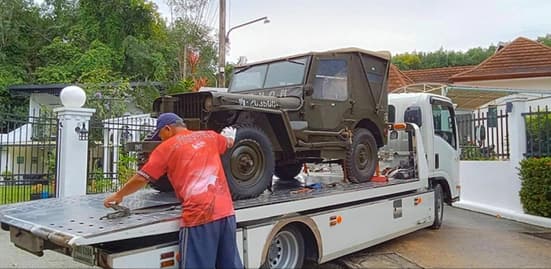
We'll be straight with you: Thailand has banned imports of used cars and other used motor vehicles since December 2019, so for most people shipping a car from Australia simply isn't an option. The Ministry of Commerce notification leaves room for a few licensed exceptions, so if you think one applies to you, ask the Department of Foreign Trade before anything is booked.
What to do instead
What to do instead
- Check before you assume
If you think a licensed exception applies to you, ask Thailand's Department of Foreign Trade first. Don't ship a vehicle and hope the paperwork catches up. - Sell at home, buy locally
Most people sell the car in Australia and buy or lease one in Thailand once they've arrived and know where they'll be living. - Plan your first weeks without it
Grab, taxis and the metro cover most daily trips in the big cities while you sort out a car.
Why we'd skip the car
- The rule — Thailand's Ministry of Commerce prohibits importing used cars, vans, buses and trucks (notification B.E. 2562, in force since 10 December 2019).
- The exceptions — a short list of licensed cases exists. Check with the Department of Foreign Trade whether one covers you before you commit to anything.
- The usual answer — sell in Australia and buy locally once you've settled.
For most private movers, the question isn't how to bring a car in — it's what to do with the one you have. Selling in Australia and buying in Thailand is the usual answer.
Not sure whether an exception applies to you? Ask your move specialist, and check with the Department of Foreign Trade before you commit to anything.
Bringing your best friend along
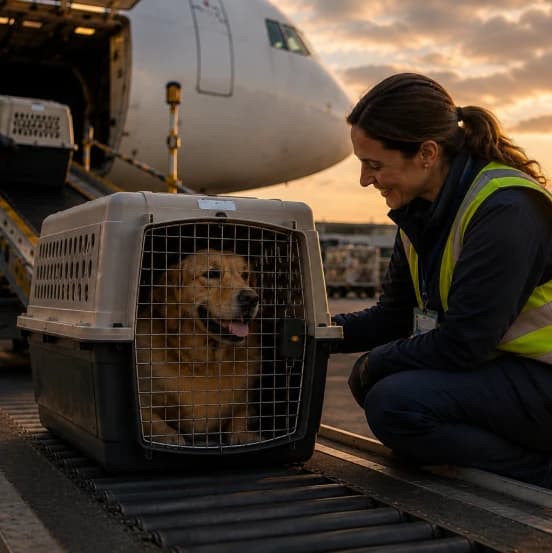
For a lot of Australians, the move only feels complete if the dog or cat comes too. Dogs and cats entering Thailand need a clean file before departure: an import permit, an official health certificate, English-language vaccination records, and travel timing that actually fits the permit window — pet travel shouldn't be an afterthought to the household shipment.
Your pet's travel checklist
- Import permit
Email the Animal Quarantine Station at your arrival airport at least 7 working days before you arrive and no more than 60 days before you fly: Form R1/1, a copy of your passport, a photo of your pet, your flight itinerary, English-language vaccination records and the microchip certificate. Allow 5 to 7 Thai business days; the permit is valid for 60 days. Thai embassies and consulates word this timing differently, so confirm it with the one for your departure country. - Vaccinations and health certificate
Dogs need rabies, distemper, hepatitis, parvovirus and leptospirosis; cats need rabies and feline panleukopenia. After a first rabies vaccination, wait 21 days before applying. Thai embassy instructions give the original official health certificate a 10-day life from government endorsement, so time it close to your flight. - Identity and breed checks
Every record needs the microchip number. Thai embassy instructions say no dog breeds are banned, but airlines set their own breed and crate rules, so check with yours and with the Thai embassy before you book. - Arrival
At Suvarnabhumi the Animal Quarantine Station sits beside baggage carousel 8 and is open 24 hours for pets travelling with you. Officers issue the import notice and licence (Forms R-6 and R-7) and collect THB 500 per animal in cash. Pets sent as air cargo can only be collected Monday to Friday, 8:30 to 16:30, not on weekends or Thai holidays.
Where your belongings enter Thailand
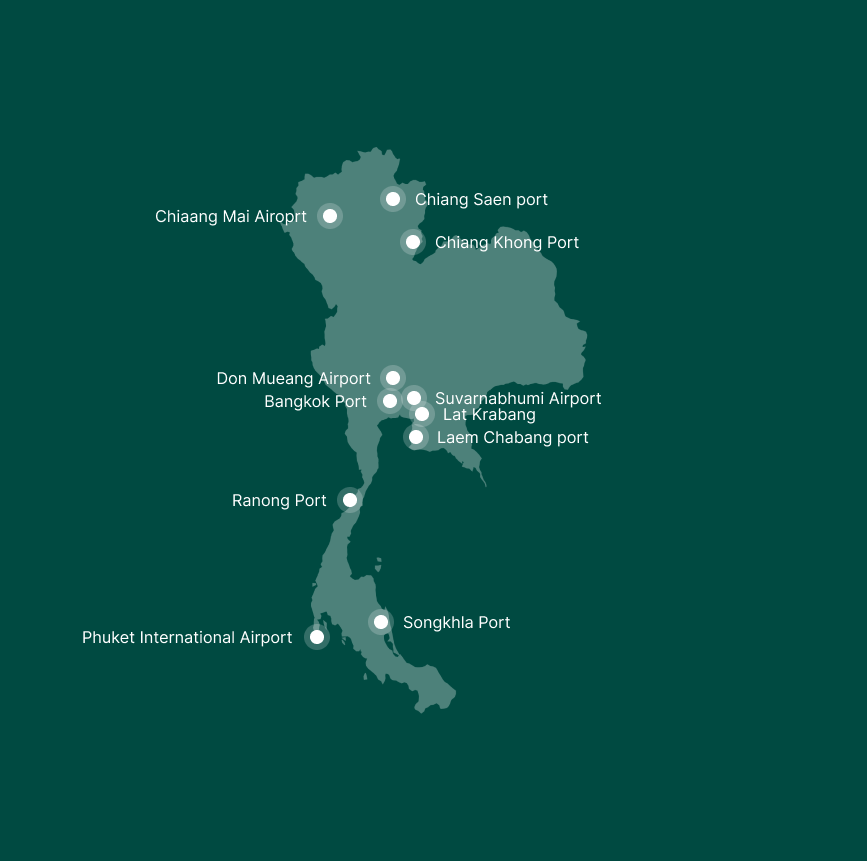
Most sea freight from Australia lands through Laem Chabang or Bangkok-area handling, while urgent air shipments usually route through Suvarnabhumi. The right gateway for you depends on your Australian departure city, shipment size, and where in Thailand you're headed.
Ports and airports used on this route
Laem Chabang Port
The main deep-sea gateway for container shipments into Thailand
Bangkok Port (Khlong Toey)
Useful for selected sea freight and local metro distribution
Suvarnabhumi Airport (BKK)
The main international air-freight entry point
Don Mueang Airport (DMK)
A secondary air gateway on selected routings
Phuket
Worth considering when your new home is in the south
Chiang Mai Airport
A secondary air option for northern Thailand
Ranong Port
A regional sea option for specific cargo patterns, not the usual household route
Songkhla and southern gateways
Niche options for specialised freight, not most family relocations
How long from your Australian city?
| From | To | Est. transit time |
|---|---|---|
| Sydney, Australia | Bangkok, Thailand | 15-19 days |
| Melbourne, Australia | Bangkok, Thailand | 16-20 days |
| Brisbane, Australia | Laem Chabang, Thailand | 18-22 days |
| Fremantle (Perth), Australia | Laem Chabang, Thailand | 13-17 days |
| Adelaide, Australia | Bangkok, Thailand | 17-21 days |
| Port Kembla, Australia | Bangkok, Thailand | 16-20 days |
| Darwin, Australia | Bangkok, Thailand | 11-15 days |
| Townsville, Australia | Laem Chabang, Thailand | 14-18 days |
Times of year that slow this route down
The Australia-Thailand corridor has a few predictable pinch points. If your dates are flexible, working around these makes life noticeably easier:
- Late March to mid-April (Songkran, Thai New Year)
Thailand slows down for its biggest holiday: offices close, ports run shorter hours, and local delivery in the final stretch can stall for days even after your shipment clears. - June to August
Australian school-holiday moves and corporate relocations push demand from Sydney, Melbourne, and Brisbane higher, which means fuller ships and less flexible sailing dates. - November to December
Year-end retail freight and holiday closures on both ends raise congestion risk worldwide. If you want to be unpacked before the holidays, aim to ship in September or October instead.
Visa options for Australians moving to Thailand
Build your shipping plan around the visa or lawful-stay route you'll actually use in Thailand — not the one you assume you'll get. Since 15 September 2026, visa-free entry for Australians is up to 30 days (it replaced the 60-day stay), and entering by land on the exemption is generally limited to twice a year. It's meant for tourism, so treat it as a way in, not a plan for living there. Everyone arriving also fills in the free Thailand Digital Arrival Card online (tdac.immigration.go.th) in the three days before landing. Thai visa categories change and the right one depends on work, family, retirement, or study plans, so confirm current rules on the official Thai eVisa and BOI LTR channels before you lock in freight dates.
The main visa families
For Australians moving to Thailand, the most common long-stay decision points are:

Visitor and short-stay visas
For scouting trips and short stays before you commit to a full household relocation.
Work and business visas
For employment, company-linked postings, or business activity that builds a real base in Thailand.
Education and training visas
For approved study or training programs with a clear institutional sponsor.
Family, retirement, and long-stay visas
For joining a spouse or family member, or settling into retirement in Thailand.
Worth knowing: if you're building a genuine household relocation, short-stay permission is usually the wrong foundation for your shipment file.
Check the official Thai eVisa system and BOI long-term resident guidance before you commit to freight dates.
Questions Australians actually ask us
Yes, sometimes.
Thai Customs can grant duty relief for used household effects when they were owned and used before shipment, arrive in reasonable quantities, and fall within the timing and documentation rules tied to your arrival in Thailand.
Usually somewhere between 11 and 22 days port to port, depending on your city.
Darwin and Fremantle tend to be the fastest sailings, while Sydney, Melbourne, Adelaide, and Brisbane run a little longer. Exact timing also depends on whether the route is direct or transshipped, and how long Thai handling and customs review take after arrival.
Only when speed matters more than cost.
Air freight can make sense for urgent essentials, work equipment, or a small high-value shipment, but it's rarely the most cost-efficient answer for a full household move.
Your inventory and your status file matter most.
A bill of lading or air waybill, passport copy, proof of permission to stay for at least a year (if you claim the household-goods exemption), your Thai address, and a plain-language packing inventory usually do more to protect your move than anything else.
Usually not with a full relocation service.
We're generally better suited to shipments from about a one-bedroom apartment upward. If you only have a few boxes, courier and parcel services are often cheaper and simpler.
Weak paperwork and timing mistakes cause most delays.
Common problems include vague inventories, shipments arriving outside the timing window tied to the owner's arrival, undeclared regulated items, and unrealistic expectations around Thai port handling or local delivery.
Almost never — Thailand bans importing used cars.
The Ministry of Commerce has prohibited used cars, vans, buses and trucks since 10 December 2019, with only a few licensed exceptions that a household move rarely meets. Selling in Australia and buying in Thailand is the usual answer; if you think an exception applies to you, check with the Department of Foreign Trade first.
It's manageable if the file is clean before departure.
Email the import permit application 7 to 60 days before you fly, get vaccinations done in time (21 days' wait after a first rabies shot), and book the original health certificate close to your flight — it's valid for just 10 days. On arrival the Animal Quarantine Station charges THB 500 per animal. Problems usually come from incomplete documents, not from the rules themselves.
Laem Chabang is the default for most container moves.
Bangkok-area handling can also work, and air freight usually enters through Suvarnabhumi. The best gateway for you depends on shipment size, your departure city in Australia, and your final destination in Thailand.
In many cases, yes — or at least a clear lawful-entry plan.
If your shipment is built around duty relief or a real household relocation, short-stay assumptions can create customs and timing problems. Confirm your visa route first, then align the freight dates around it.
Usually yes, but not in every category.
Rent, everyday services, and daily living are often cheaper, but imported goods, international schools, premium housing, and weak relocation planning can still make the first year expensive.
Sea freight is usually the best-value answer.
Shared container space (LCL) works for smaller but still meaningful household moves, while a dedicated container (FCL) is cleaner for larger family homes. Air freight is usually for urgent essentials, not the whole house.
So, what's it actually like to live in Thailand?
Before we talk boxes, let's talk about the life waiting on the other side. Thailand hosts one of the largest expat communities on earth — an estimated two to three million foreign residents, with more than 100,000 newcomers arriving each year. Some come for a posting, some for retirement, some because they visited once and never quite stopped thinking about it.
For Australians specifically, the route has a practical advantage: your paperwork is already in English, flight times are manageable at 7 to 10 hours, and the sea corridor is well used. The real adjustment isn't distance — it's not letting a familiar-feeling regional move lull you into treating Thai entry casually. The paperwork still needs the same discipline as a move to somewhere less familiar.
Our biggest tip? Start earlier than feels necessary. Australians who love their first year in Thailand are usually the ones who gave themselves time — to compare visa options, choose between city and coast, and ship their belongings without paying rush prices. The logistics themselves are the easy part: Thailand's ports and airports are excellent, with frequent sailings and flights from every major Australian city. That's where we come in — helping you land softly, from first quote to the day your photos go up on new walls.
7-10 hrs
Typical flight time between major Australian cities and Thailand
2,000,000+
Foreign residents already calling Thailand home
7%
Thai VAT benchmark that often matters on taxable imports
What changes in the cost of living
Thailand is usually cheaper than Australia for rent, everyday services, and eating out, but imported goods and international-school lifestyles can eat into that advantage quickly.
Bangkok carries the highest mainstream cost profile, especially for central condos, school runs, and imported groceries. Chiang Mai and many secondary cities are noticeably lighter on the wallet, while Phuket can feel surprisingly expensive because of tourism and villa demand.
Budget for two phases, not one: the landing period, where furniture rental and setup costs run high, and the steady-state period once your household is properly installed.
Getting around is usually cheaper than in Australia, but your real transport cost depends heavily on whether you lean on the BTS, MRT, and ride-hailing, or choose a car-centric lifestyle.
Thailand still offers strong value overall. The mistake is assuming lower daily costs automatically make the move cheap when the import file is weak, the housing choice is wrong, or the school strategy gets decided too late.
Is it safe? The honest answer for Australians

Is it safe? The honest answer for Australians
Short answer: yes, and more so than many Australians expect. Violent crime in Thai cities is rare and the famous Thai warmth extends genuinely to foreign residents. The routine risks are the tourist-zone classics — pickpockets in crowded markets, an occasional creative taxi fare — and ordinary awareness handles both. Check Smartraveller before you plan a road trip: as of mid-October 2026 it advises a high degree of caution overall, no travel within 10 km of the Cambodian land border, and reconsidering travel to Yala, Pattani and Narathiwat in the deep south.
Traffic is the real safety topic here. Bangkok's roads look like organised chaos and mostly are; plenty of Australians happily rely on Grab, the metro, and taxis instead of driving. Renting a motorbike in the countryside is common — just get an international driving permit, wear a proper helmet, and ride assuming nobody's seen you.
On natural risk: Thailand sits in a region known for monsoons and the occasional tremor, but it's calmer than most of its neighbours. Rainy season (roughly May to October) brings brief street flooding rather than catastrophe, and city drainage teams have seen it all before.
Salary expectations after an Australian move
Most Australians moving to Thailand need to recalibrate salary expectations. Local pay looks low against Australian benchmarks, while regional packages from multinational employers can still work out well.
The real question isn't salary in isolation — it's salary against rent, school fees, tax treatment, and whether your role is priced for the local market or the regional one.
Technology and digital roles
Bangkok remains the strongest market for tech, product, and regional operations roles, with better upside in multinational or venture-backed companies than in purely local SMEs.
Finance and corporate management
Regional finance, legal, and management roles can pay well by local standards, especially when housing or schooling support is part of the package.
Sales and business development
Commercial roles tied to regional revenue can still be attractive, but scrutinise commission structures and local-market pricing closely.
Education and training
International schools and specialised training roles are a materially different market from mass-market teaching positions — don't price them the same.
Hospitality and tourism
There are good management-track roles in hospitality, but don't assume an international-sounding employer automatically means Australian-level pay — check the actual number before you get attached to the job.
Thai personal tax considerations for Australians
Once you spend enough time in Thailand, tax residency stops being background noise and becomes a real planning issue. The magic number is 180 days in a calendar year — cross that and you're a Thai tax resident. Residents are taxed on Thai-sourced income and on foreign income remitted into Thailand; non-residents only on what they earn locally.
This is one area where stale expat advice ages badly. Since 1 January 2024, foreign income you earn in a year you're a Thai tax resident (180 days or more in Thailand) is taxable if you bring it into Thailand — even if the money arrives in a later year. Income earned before 2024, or in a year you weren't a resident, isn't taxable when you remit it. That's an important shift for retirees living on Australian pensions and remote workers paid from home. Before you build a long-stay life around assumptions, confirm current treatment with a qualified adviser rather than relying on forum folklore, and check whether the Australia–Thailand tax arrangements apply to your situation.
Finding work in Thailand as an Australian
Thailand can work well for Australians with a clear market fit, but it's not a place where general enthusiasm substitutes for visa, language, and employer reality.
1. Start with credible job channels
Use Thai and regional job boards, sector recruiters, and direct company outreach rather than waiting for expat forums to do the work for you.
2. Focus on Bangkok first if career matters
Bangkok remains the main hub for corporate, regional, and international roles. Other cities can be excellent for lifestyle but weaker for employment.
3. Build the visa path into your search
A role is only real if the employer can support the right status and the paperwork can be executed lawfully.
4. Use networks that reach decision-makers
Industry contacts, alumni circles, recruiters, and direct introductions usually outperform passive job-board browsing.
5. Treat work-permit admin as part of the offer
To work legally you'll generally need a Non-Immigrant Visa "B" and a valid work permit arranged through your employer.
Thailand is also expanding long-term options like the LTR Visa (Long-Term Resident) for highly qualified professionals who want to live and work here for the long haul.
Important update: Since October 2025, Thailand has mandated the e-Work Permit platform for all new work-permit applications, renewals, and cancellations. Paper permits are being phased out, and everything now goes through eworkpermit.doe.go.th.
Schools, hospitals, and everyday admin
Thailand attracts families partly because private healthcare is strong, international schooling is widely available in the main hubs, and service standards feel high relative to cost.
The split between premium and ordinary provision matters. Bangkok offers a very different schooling and hospital landscape from smaller cities, so it's worth researching your specific destination rather than assuming Bangkok's options apply everywhere.
Administrative processes are manageable but still lean on paper forms, in-person visits, and local practice more than a fully digital flow — bring patience and, occasionally, a book.
In practical terms, Australians who plan neighbourhood, school, and hospital strategy before the shipment arrives tend to settle in faster than those who leave it for later.
Getting your baht: smart ways to handle money
Sorting out Thai Baht access is one of those small decisions with a surprisingly big impact on your budget. Here are the main options, from best value to most convenient.
1. Licensed exchange booths
They often beat airport and bank rates, especially in Bangkok, and work well for larger conversions once you're settled.
Pros:
- Strong rates for larger amounts
- Fast access in major districts
- Useful when rent or deposits need cash support
Cons:
- You have to handle physical cash
- Rates vary by operator and location
2. ATMs and local withdrawals
Convenient, but a fixed withdrawal fee of around 220 THB (roughly AUD $10) plus your Australian bank's own charges adds up quickly if you rely on it as your main strategy.
Pros:
- Easy access nationwide
- Works well for short-term liquidity
- Good fallback while local banking gets set up
Cons:
- Repeated fee drag
- Exchange rate can be mediocre depending on your card
3. Multi-currency cards and apps
Useful for controlled spending and transparent conversion, especially in the first few weeks after you land.
Pros:
- Cleaner rate visibility
- Good for budgeting
- Safer than carrying large amounts of cash
Cons:
- Cash-heavy parts of Thailand still reduce their usefulness
- ATM and weekend-conversion rules still apply
4. Exchanging before you leave Australia
Convenient for peace of mind, but Australian banks typically charge 3 to 10% markups on baht — the least cost-effective option on this list by a wide margin.
Pros:
- Immediate access to Thai Baht on arrival
- Less to think about at the airport
Cons:
- Poor exchange rates
- Limited flexibility once you've committed
What most long-term Australian expats settle on: local exchange booths for larger sums, a multi-currency card for daily spending, and the occasional ATM run when cash is unavoidable.
Climate and weather: what Australians should expect

Climate and weather: what Australians should expect
Thailand is warm all year, but for many Australians the real adjustment isn't heat alone — it's the humidity, the monsoon timing, and the urban flood patterns that come with it.
- Hot season (roughly March to May) with heavy daytime heat and heavy reliance on air conditioning
- Rainy season (roughly June to October) with bursts of intense rain, travel disruption, and local flooding in some districts
- Cooler season (roughly November to February) which is usually the easiest landing window for new arrivals
The climate affects storage, mould risk, furniture choice, and even what's worth shipping from Australia versus replacing locally.
Bangkok, Phuket, Chiang Mai, and the islands don't feel the same in practice — microclimate matters when you're choosing where to live.
Plan around the weather instead of treating it as background noise, and your first few months in Thailand will usually go a lot more smoothly.
Door-to-door: from your old home in Australia to your new one in Thailand
We manage the whole journey from your Australian pickup point through Thai customs and final delivery — one plan built around your actual shipment, not generic mover language.
1. Packing and file review
Before your things leave Australia, we align the packing plan with your customs file and the risk profile of what you're bringing. That usually includes:
- Export-grade cartons and wrapping
For ordinary household goods that need to survive multiple handling points along the way. - Protection for fragile items
For glass, electronics, artwork, and anything that gets expensive if it's repacked badly. - Crating where needed
For oversized, fragile, or high-value pieces that need proper structural protection.
Full packing service: Don't want to pack yourself? No problem. Our team can pack everything, including furniture and oversized items — just fill out the contact form and one of our move specialists will get in touch to plan it with you.
2. Pickup at your Australian address
Collection is scheduled around packing completion, export cut-off, and the actual route you're using — not an optimistic generic timeline.
3. International freight and Thai customs
We move your shipment by sea or air and handle the Thai customs conversation on your behalf, from the import file to inspection risk to final release.
4. Delivery to your Thai address
Once customs gives the all-clear, we book delivery around local access, building rules, and your actual receiving window at the other end.
5. Unloading and placement
We also offer unpacking. Your specialist places your belongings where you want them, so your new home in Thailand feels like home from day one.
Loved by Australians settling into Thailand
Real stories from Australians who unpacked their new lives with Expats Direct:
Your Australia to Thailand move, step by step
Your Australia to Thailand move, step by step
Tell us about your move — a minute, tops.
Review your route, timing, and customs assumptions.
Pick sea, air, or a mix of both for your shipment.
Prepare your import file before packing starts.
Confirm your delivery address, access, and timing in Thailand.
Follow along as we coordinate customs and handling on your behalf.
Unpack, exhale, and start exploring your new home.