Move your home to Australia from the UK
We pack, ship and handle customs.
Guide for Britons relocating to Australia
Sea freight from Southampton or Felixstowe often reaches Fremantle first — roughly 35–45 days, though routing and timing vary by carrier — with Melbourne, Sydney, Brisbane and Adelaide another week or so further on. Door-to-door, with UK collection at the start and Australian delivery once biosecurity clears you, most households plan on 8–12 weeks, occasionally 14 in the busier months.
Here's the one that's different from most routes: Australia checks what you're bringing, not just where you're from. The Department of Agriculture, Fisheries and Forestry (DAFF) assesses every shipment of personal effects, wherever it comes from, and inspects the ones with items of biosecurity concern. Outdoor kit — boots, bikes, garden tools, camping and golf gear — needs to be properly clean before it's packed, or it can be held for treatment at your cost.
The genuinely good news: Australia's mains supply is 230V/50Hz, the same nominal supply as the UK, so most electrical appliances that would be stranded on a Canada or US move can simply travel with a plug adapter. Always check the rating label first — it's weight and freight cost, more than voltage, that usually decides what's worth bringing.
An ETA or eVisitor lets you fly in for a holiday, but it isn't a route to living or working here long-term. If you're 18 to 35 inclusive, the Working Holiday visa (subclass 417) is open to British passport holders on more generous terms than most nationalities get, thanks to the Australia-UK free trade agreement — a common first step before a skilled or partner visa.
Because the UK and Australia both drive on the left, a right-hand-drive car is at least road-legal in principle here — genuinely rarer among our routes — though you still need the appropriate import approval before it's worth the crossing. Our door-to-door quote covers Australian port fees, careful packing, and delivery to your door, with no storage charges hiding in the small print.
A move from the UK to Australia has three real stages: getting your things properly prepared and out of Britain, the long sea crossing, and Australian biosecurity and customs at the receiving port. Most of the outcome is decided before the container is even loaded — by how thoroughly outdoor items are cleaned, how the personal effects statement is completed, and whether your inventory clearly separates genuine used belongings from anything that needs its own treatment or permit.
We handle the whole chain: collection and export packing at your UK address, sea or air freight with confirmed schedules, the DAFF and Australian Border Force (ABF) paperwork, port and biosecurity clearance at Sydney, Melbourne, Brisbane, Fremantle or Adelaide, and delivery to your Australian door. One Move Manager stays on your case from the first quote to the last box carried in — you won't be passed around.
Below we walk through what actually matters for a British mover: how DAFF biosecurity and the personal effects statement work, realistic transit times from each UK port, which Australian visa routes British nationals actually use, what's restricted, and honest, on-the-ground detail about settling into life in Australia after the UK.
How we get you there
We plan your UK-to-Australia move around the bits that trip people up — biosecurity cleaning, the personal effects statement, and DAFF clearance — with a plan built for your exact shipment. Three simple steps, one specialist on your side, and the right route chosen for your timeline.
Tell us about your move
Your UK collection address, where you're headed in Australia, and roughly what's coming. You get a clear plan, a timeline, and a price up front — no guessing.
Meet your Move Manager
One person builds your shipment plan, flags anything that needs biosecurity cleaning or a permit, and checks the inventory before anything leaves Britain.
We handle the rest
Collection, export, the crossing, DAFF and ABF clearance, and delivery to your Australian door. You get on with settling in; we keep it running to plan.
Times of year that shape this route
UK-to-Australia household moves follow a rhythm set by the Australian school year, employer relocations, and the transit time itself:
- October to December
The busiest stretch for British families, timed so an 8–12 week crossing lands well before the Australian school year starts in late January or early February. Vessel space out of Felixstowe and Southampton can tighten here — booking 8–10 weeks ahead is the sensible move. - April to May
A second, smaller peak driven by employer-sponsored moves timed around the Australian financial year, which starts on 1 July. - July to September
Often quieter for household moves, and frequently the sweet spot — better vessel availability and shorter lead times for your shipment.
Australian biosecurity and customs, minus the headache
Australia runs two checks on an incoming household shipment: an Australian Border Force (ABF) customs assessment for duty and GST, and a Department of Agriculture, Fisheries and Forestry (DAFF) biosecurity assessment, with an inspection where the paperwork or the goods call for one. The biosecurity side is the one that genuinely differs from most other destinations — Australia is an island with no land borders, and it protects that status by checking personal effects from every origin, not just certain countries.
There's also a UK export leg to sort before anything leaves Britain. We take care of the UK export documentation for you — the key is that the inventory and values on it line up with what's declared to ABF and DAFF on the Australian side.
Australia checks incoming household goods twice, and the two checks run separately. Australian Border Force (ABF) decides whether your shipment qualifies for the unaccompanied personal effects (UPE) concession, which clears it without customs duty or GST. The Department of Agriculture, Fisheries and Forestry (DAFF) assesses every UPE shipment for biosecurity risk, whether or not the concession applies. ABF's criteria are that you are 18 or over and arriving from outside Australia, and that your furniture and household goods are your own, meant for your use in Australia, and owned and used by you for the 12 months before you leave. Personal clothing, footwear and grooming items (fur apparel and perfume concentrates excepted) have no 12-month test, but only Australian citizens and holders of a permanent or special category visa who are taking up or resuming residence can claim them. ABF has the final say on eligibility.
The concession does not cover alcohol, tobacco, motor vehicles and vehicle parts, commercial goods, goods left to you in a will, or anything sent after you arrive. Goods you have owned for less than 12 months have to be declared, and they are assessed for duty and tax.
- In the United Kingdom · before export
Look for goods that need a licence
Controlled firearms and cultural objects need an export licence first, and CITES-listed items need an APHA permit unless the household effects exemption applies. A UK licence isn't permission to import, so check the destination's rules as well.
- In the United Kingdom · before the goods leave
Appoint an agent for the C21e request
A UK-based forwarder or customs agent can send the C21e Customs Clearance Request for you. It uses the code for private exportations of non-commercial goods, which has no value limit. HMRC asks for the declaration to be submitted as 'arrived' before departure on certain routes, Eurotunnel and Dover Eastern Docks among them.
- For Australia · while you plan the shipment
Arrange transport and write your packing list
The concession only works if the shipment is arranged before you arrive in Australia, so book it first and keep evidence that it goes with your move, for example your flight ticket or an Australian employment contract. Goods you have sent on after you arrive do not qualify. For the packing list, number every box and note what is inside and what each item is made of, such as a metal bed frame, a wooden chair or a cane basket. DAFF counts vague entries like 'misc' among its items of concern, and gear you have scrubbed free of soil and plants is still inspected.
- For Australia · as you prepare the paperwork
Fill in the B534 in English
The Unaccompanied Personal Effects Statement (B534) is a legal declaration to both ABF and DAFF. You can download it in other languages, but it has to be completed in English, in block letters, with any corrections initialled. It asks yes/no questions about the kinds of goods you are sending and wants details for each yes, so declare anything of biosecurity concern: an undeclared risk item can lead to prosecution. If someone else clears the goods for you, DAFF requires them to sign a statutory declaration saying they act on your behalf.
- With ABF and DAFF · ahead of arrival
Lodge with Border Force before DAFF
DAFF cannot begin until ABF has assessed the UPE, so go to ABF first: at one of its counters (bring 100 points of ID), by email to its state office, or through a customs broker. Whichever route you take, ABF wants the signed B534, the shipping document or a delivery order, the packing list, and receipts for anything you have owned for under 12 months. From 8 July 2026 DAFF has accepted UPE documents only through COLS (its Cargo Online Lodgement System), and emailing them no longer works. It asks for them, where possible, 5 to 7 days before a ship arrives or 24 hours ahead for air freight.
- With DAFF · once your paperwork is in
Be ready for a DAFF check
If you are not an approved DAFF account client, a minimum up-front fee has to be paid in COLS before DAFF assesses your lodgement. DAFF then reads the B534 and packing list to pick out goods of biosecurity concern. For COLS lodgements it aims to respond within 1 business day if urgent and 2 if not, though incomplete or incorrect paperwork can slow it down. Anything flagged is inspected; treatment (steam cleaning included), export or destruction is at your expense, and the approved site your removalist uses may add handling and storage fees that DAFF does not set. ABF releases the shipment only once DAFF has cleared it.
The documents Australian customs and biosecurity usually want to see
Exactly what's needed varies with your shipment and immigration status, but these are the papers that usually travel with a household shipment:
- UK passport, your Australian visa or immigration documents (visa grant notice, confirmation of permanent residence, or whatever your basis for entry is), and proof that the shipment goes with your move, such as an airline ticket or an Australian work contract
- B534 (Unaccompanied Personal Effects Statement) — a legal declaration that asks yes/no questions about the kinds of goods you're shipping (you give details for each kind you answer yes to, or are unsure about). It has to be completed in English and lodged with Australian Border Force, ideally before your goods arrive
- A detailed packing list — numbered box by box, saying what is in each box and what each item is made of
- Bill of Lading (sea freight), Air Waybill or delivery order from your freight forwarder
- UK export paperwork — we handle this at the UK port; it's the UK side of your file rather than something Australian officers ask for
- Identity documents for ABF — to lodge at an ABF counter you need 100 points of ID: a primary document such as your passport, a photo ID, and a document showing your primary residence
- Your Australian delivery address and consignee details
- Receipts or evidence of value for anything you've owned for under 12 months
- Evidence of ownership and use for goods you're claiming the duty/GST concession on — ABF may ask for receipts, photographs or a statutory declaration
DAFF biosecurity: inspection, cleaning, and the excluded categories
DAFF's Biosecurity Import Conditions system (BICON) sets what's permitted, what needs treatment, and what's refused outright — it's worth checking specific items before you pack. The things DAFF is most interested in:
- Soil, mud, or plant matter on outdoor kit — walking boots, bikes, garden tools, camping gear, golf clubs, and anything used outdoors needs a proper clean with a stiff brush and soapy water before it's packed
- Food, seeds and plant material, straw or sawdust used as packing, solid-timber packaging that hasn't been treated to ISPM 15, and items made from animals or plants (rawhide, bone, feathers, antlers and animal hair may need treatment)
- DAFF applies seasonal Brown Marmorated Stink Bug (BMSB) measures to goods shipped between 1 September and 30 April (inclusive); the shipped-on-board date on the Ocean Bill of Lading decides which side of that line you fall on. The United Kingdom is on DAFF's emerging-risk list, so goods shipped from the UK in that window can be picked for random onshore inspection. Household goods imported as UPEs on a B534 are exempt from mandatory BMSB treatment, but every UPE faces increased onshore inspection, and the exemption holds only if ABF approves every item in the consignment under concessional tariff 99. DAFF reviews the measures through the season, so check its current BMSB page, and the position for every country in your shipping route, before you book or load.
- Alcohol and tobacco — these sit outside the duty/GST concession however long you've owned them. Firearms and other weapons need ABF's permission before they can be imported, and go on the B534 too
- New goods, commercial quantities, or anything that looks more like stock than personal belongings
When your things arrive after you do
On a UK-to-Australia sea move, your belongings usually land weeks after you've already flown over. That's completely normal — ABF lets personal effects arrive before or after you, provided the shipment is tied to your move and the transport was arranged before you arrived, and ABF and DAFF process them on their own timeline once the shipment and your B534 statement are both in the system. The inventory has to match what's actually travelling by sea; a gap between what's declared and what turns up at the port is far slower and pricier to untangle later than it is to get right at the start.
What you can import to Australia

Personal belongings

Used clothing

Household appliances

Fragile items

High-value items

Large items & furniture
Timber furniture inspected for pests, at your cost

Excess luggage

Pets
Permit and quarantine for cats/dogs, except compliant arrivals from New Zealand and Norfolk Island

Vehicles
Import approval before shipping; duty payable
What Australia restricts

Illicit drugs & drug paraphernalia

Explosives & fireworks

Biosecurity risk items (soil, plants, untreated wood)

Hazardous chemicals

Corrosive substances

Counterfeit & pirated goods

Ivory & protected wildlife products

Lithium batteries & certain power equipment

Flammable liquids & gases

Firearms & weapon parts

Prescription & non-prescription medicines

Counterfeit currency

Poisons & pesticides

Objectionable & prohibited publications

Knives & certain bladed items

Tobacco products

Other hazardous or dangerous goods

E-cigarettes & vapes
Controlled import; permit needed

Asbestos
Banned, including in vehicles
How much can you bring?
We're set up for household relocations from the UK to Australia, not parcel forwarding, so there's a sensible minimum:
- Minimum: 6 boxes
Roughly a studio's worth of belongings once the furniture stays behind. Below that, a courier or parcel service will usually serve you better and cost less.
- No upper limit
From a one-bed flat to a full family home across several containers — we've shipped it all to Australia before.
For a full household, most families ship a 20ft or 40ft container. A single room or a studio's contents usually travels as LCL (Less than Container Load) groupage, consolidated with other UK-to-Australia shipments at the UK port.
The forms and official guidance, in one place
- DAFF — moving to Australia or importing personal effects: official DAFF guidance for migrants
- DAFF — preparing your personal effects for shipment: personal effects preparation guide
- DAFF's Biosecurity Import Conditions system (BICON) for checking specific items: BICON item search
- Australian Border Force — the duty and GST concession for household goods you ship: ABF unaccompanied personal effects guidance
Where to check Australian biosecurity guidance

Department of Agriculture, Fisheries and Forestry biosecurity guidance for people moving to Australia, straight from the source.
Taxes and duties, in plain English
For a British mover, the main question is whether your shipment qualifies for the duty and GST concession on unaccompanied personal effects. This is an Australian Border Force concession, separate from the DAFF biosecurity check — you can clear one and still need to satisfy the other.
The general rules
- Unaccompanied personal effects you've owned and used overseas for 12 months or more before you leave for Australia can generally enter duty and GST free, once properly declared on the B534 statement.
- New goods, replacement purchases, items owned for less than 12 months, and goods of a commercial nature can attract duty, GST, or other charges — whether or not they were bought in the UK.
Who the 12-month rule applies to
- The concession isn't limited to permanent migrants. ABF's tests are about you and your goods: you're 18 or over and arriving from outside Australia, the goods are yours and meant for your own use in Australia, you owned and used them for the required period before you left, and they were sent in connection with your move with the transport arranged before you arrived. Furniture and household goods carry a 12-month test and no permanent-residency requirement. ABF makes the final decision on eligibility, so check your own position before you build your shipment plan around it.
- If you're an Australian citizen or hold a permanent or special category visa, one thing works in your favour: personal clothing, footwear, and grooming items (excluding fur apparel and perfume concentrates) don't need the 12-month ownership test — only the rest of your household effects do.
The categories that need a bit more care
Even where the concession applies, these are best kept separate rather than buried in a generic household list:
- Alcohol and tobacco
- Firearms and anything weapons-related
- New goods, or things bought just before you ship
- Motor vehicles and vehicle parts, which are excluded from this particular concession and assessed on their own basis
- Anything owned for less than 12 months, unless it's covered by the clothing and grooming exception above
A UK-to-Australia file is nearly always cleaner when your qualifying used belongings are clearly separated from everything else. The things that blur the line — new electronics, unopened purchases, a duplicate appliance bought right before departure — are worth flagging before the container is packed, not after it's sitting at an Australian port awaiting inspection.
If you're not sure whether something qualifies for the concession or needs declaring on its own, ask us before it ships. Sorting a category question at origin is quick; sorting it after arrival, with the shipment held for reassessment, is not.
Insuring your shipment
A UK-to-Australia crossing is one of the longer international moves your belongings can make, so cargo insurance is well worth having — especially on anything that matters to you or carries real value.
Why it's worth having
A UK-to-Australia sea voyage puts your belongings through a long international transit with a few genuine risks:
- Open-ocean weather across a multi-week route, whichever ocean it crosses
- Handling or storage at the UK departure port or the Australian receiving port
- Biosecurity inspection, container stripping, or treatment at the Australian end
- Accidental loss, breakage, or damage during loading, transit, or the final Australian delivery leg
What's usually covered
It depends on your policy, but cargo cover for a UK-to-Australia household move typically includes:
- Protection during the sea or air leg between UK and Australian ports
- Cover for specific named risks such as fire, theft, or water damage
- Limits, exclusions, and conditions based on your declared shipment value
Always go through the policy terms, exclusions, and declared values with your broker or insurer before you commit to cover.
How to get insured through us
You can arrange cargo insurance for your UK-to-Australia shipment through:
- A general insurer offering marine or cargo cover
- A specialist cargo or relocation insurance broker
- Your bank or financial provider, where they offer it
- Our own cargo insurance, arranged as part of your move.
Note: our cover is charged at 3% of your declared shipment value.
Visa and immigration routes for British nationals moving to Australia
British nationals have several genuine routes into Australia, from a working holiday to a full skilled-migration pathway. Which one fits comes down to your age, your occupation, whether you have a job or partner already in Australia, and how long you're planning to stay. Requirements and points thresholds change often, so always confirm the current rules with the Department of Home Affairs before you lock in any relocation or shipping decisions.
The main routes for British nationals
The pathways British nationals most commonly use to relocate to Australia:
ETA and eVisitor entry
British citizens can apply for an Electronic Travel Authority (subclass 601) or an eVisitor (subclass 651) for tourism or short business visits, with stays of up to three months at a time. Neither lets you live or work in Australia.
Working Holiday and employer-sponsored work
The Working Holiday visa (subclass 417) is open to British passport holders aged 18 to 35 inclusive — a wider age range than most nationalities get, under the Australia-UK free trade agreement. Each visa runs for 12 months, and UK passport holders who apply on or after 1 July 2024 can hold up to three in total, not necessarily back to back and with no specified work required. You usually cannot work for one employer for more than six months on each visa, and the four-month study limit applies, but since 1 January 2024 the six-month limit does not apply to many jobs, including hospitality and tourism, agriculture, health, aged and disability care and childcare. Employer-sponsored work visas cover skilled roles where an Australian business sponsors you directly.
Skilled migration (subclasses 189, 190, 491)
Australia's points-tested skilled visas: the Skilled Independent visa (189) needs an invitation but no state or employer sponsorship; the Skilled Nominated visa (190) adds nomination by a state or territory government, and each one sets its own criteria, so ask the nominating agency what it expects of you; the Skilled Work Regional visa (491) is a provisional visa for regional areas, with a pathway to permanent residence once you've lived and worked in a regional area. All three are points-tested: 65 points is only the minimum to be considered, and the score you need to be invited varies by occupation and round.
Partner and family visas
Partner visas (onshore subclass 820/801 or offshore 309/100) let British nationals join an Australian citizen, permanent resident, or eligible New Zealand citizen partner. Other family-sponsored routes exist for parents and other relatives; check Home Affairs for the current processing times.
Worth knowing: an ETA or eVisitor is for visiting, not settling, so work out which visa you will actually hold before you book the shipment. ABF asks for proof that your goods are being sent in connection with your travel to Australia, such as an airline ticket or a work contract, and your visa can affect which goods qualify for the duty and GST concession.
For the accurate, current requirements, always check the Department of Home Affairs' official website before you apply or finalise your plans.
UK departure ports and Australian arrival ports
UK household shipments to Australia leave through a handful of specialist container and groupage ports, then arrive at one of Australia's main gateways for biosecurity and customs clearance before onward delivery. The UK port you leave from and the Australian port you arrive at both shape your transit time, your cost, and how straightforward that final delivery leg is — services from the UK often call at Fremantle first before continuing on to the eastern seaboard, and whether a sailing goes through the Suez Canal or round the Cape of Good Hope depends on the carrier.

The main UK departure and Australian arrival ports
Felixstowe (Suffolk)
One of the UK's busiest container ports and the usual choice for east and southeast England. Plenty of containerised UK-to-Australia shipments sail from here.
Southampton
A major south-coast port handling plenty of household and groupage traffic to Australia.
Tilbury (London)
The Thames-side container port for London and home-counties collections.
Fremantle (Perth)
Western Australia's main port and often the first Australian port of call from the UK, which tends to make it the quickest arrival point.
Port of Melbourne
Australia's largest container port, handling plenty of household and groupage traffic from the UK.
Port Botany (Sydney)
New South Wales' main container port and the usual choice for Sydney and surrounding deliveries.
Port of Brisbane
The Queensland gateway for southeast Queensland deliveries.
Port Adelaide
The South Australian arrival port for Adelaide and surrounding areas.
UK-to-Australia route timings
| From | To | Est. transit time |
|---|---|---|
| Southampton, UK | Fremantle, Australia | 35-45 days |
| Southampton, UK | Melbourne, Australia | 38-48 days |
| Southampton, UK | Sydney, Australia | 40-50 days |
| Felixstowe, UK | Fremantle, Australia | 36-46 days |
| Felixstowe, UK | Melbourne, Australia | 39-49 days |
| Felixstowe, UK | Sydney, Australia | 41-51 days |
| Felixstowe, UK | Brisbane, Australia | 42-52 days |
| Tilbury (London), UK | Adelaide, Australia | 40-50 days |
Our door-to-door service, from the UK to Australia
Since 1999 we've been moving people from the UK to Australia — from collection at your British address through export customs, the sea crossing, Australian biosecurity and customs clearance, and delivery to your new home. We handle every step, so you can put your energy into the move itself rather than the logistics.
1. Collection and packing at your UK address
Our UK team collects and packs your things for the crossing, and flags anything that needs a biosecurity clean before it goes near a box. Professional materials include:
- Packing boxes
In a range of sizes and rated for international sea freight. - Bubble wrap
For the fragile things — glassware, ceramics, electronics — to keep breakages down over a long ocean transit. - Wooden crates
For large, valuable, or awkward items that need proper reinforcement over a long distance.
2. UK export and port handling
We sort the UK export documentation, load the container at your departure port (Felixstowe, Southampton, or Tilbury), and hand it safely to the vessel.
3. The crossing and Australian biosecurity and customs clearance
We book the sea or air freight as agreed, track the container on its way to Australia, and manage the DAFF biosecurity check and ABF customs clearance at Fremantle, Melbourne, Sydney, Brisbane or Adelaide on arrival. The customs and biosecurity sections above cover exactly what's needed.
4. Delivery to your new Australian home
Once your shipment clears biosecurity and customs, we arrange the final leg and the drop at your Australian address.
5. Unpacking and setting up
Our local delivery team places the furniture and boxes where you actually want them, so you can start settling in rather than facing a mountain of unpacking on your own.
One person on your side the whole way
Our UK-to-Australia support is built around a single contact: a dedicated Move Manager who owns your file from the first quote through UK collection, export, the crossing, DAFF and ABF clearance, and Australian delivery. You're not handed off between teams at each stage.
On an Australia move, that continuity really matters, because your B534 personal effects statement and your biosecurity preparation have to stay consistent across every document in the file. A gap between what's declared and what actually turns up at the Australian port causes friction that's slow and costly to fix afterwards. One accountable person who knows the whole file is how that gets spotted before it becomes a problem.
From collection in Britain through loading at Felixstowe or Southampton, the sea crossing, DAFF and ABF clearance, port release, and the final delivery to your Australian door — your Move Manager stays in touch and keeps you posted at every stage.
Talk to a real person now
Bringing a vehicle from the UK to Australia
This is one of the few routes where a UK car isn't automatically a non-starter: both the UK and Australia drive on the left, so a right-hand-drive vehicle is at least the correct configuration for Australian roads. That doesn't make it simple, though. You must obtain the appropriate import approval before shipping. The personal-effects pathway is a concessional RAV entry approval applied for through ROVER, and it has strict eligibility rules, including continuous ownership and use overseas for at least 12 months immediately before first arriving in Australia with the intention to remain indefinitely. An approved vehicle must then satisfy its approval conditions, be entered on the Register of Approved Vehicles (RAV), and pass state or territory registration requirements.
The vehicle-import essentials

The vehicle-import essentials
- Concessional RAV entry approval through ROVER
You apply after you arrive and need the approval before the vehicle ships. For the personal-effects pathway, you must own the vehicle when you apply, have become its owner while living overseas, and have owned and used it overseas continuously for at least 12 months immediately before first arriving in Australia with the intention to remain indefinitely. The application has to be submitted within 6 months of your first arrival, and you can't have been granted a personal-effects import approval in the last 5 years. An application fee of $50 plus a RAV charge (about $7.20 for a passenger vehicle) applies and is not refundable once paid, so check ROVER for the current amounts. Further eligibility limits apply, so confirm the current official criteria before booking freight. - Ownership and transport documents
The application asks for photos of the vehicle (front, rear, both sides, the VIN and compliance plate, odometer and engine), and the department lists documents such as your UK V5C registration record, purchase receipt, servicing records, insurance, passport and visa papers. They all need to line up. - Compliance and registration after arrival
An approved vehicle still needs state or territory registration, roadworthy checks, and confirmation it's on the RAV database before you can drive it.
Costs to expect
- Freight, handling, and destination charges at the UK departure port and the Australian arrival port
- The concessional RAV entry approval application fee, plus any applicable duty, GST, or luxury car tax depending on the vehicle's value and your import basis
- State or territory registration, inspection, and compliance costs after arrival
The department's 8-step guide also expects the car to be steam-cleaned inside and out before it ships, with air-conditioning gas removed and asbestos testing done where necessary. Even with the right-hand-drive advantage, shipping, approval, and compliance costs add up quickly on an older or lower-value car — for many British movers, selling in the UK and buying in Australia still works out cheaper than importing. It's worth costing both options properly before you commit either way.
Moving from the UK to Australia with your pet
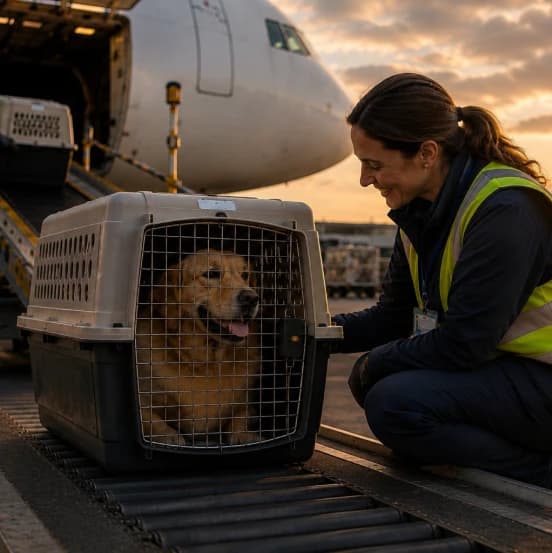
Australia is rabies-free and intends to stay that way, so bringing a dog or cat from the UK is a government-supervised process with its own timeline, separate from your household shipment and your own visa. The UK is on DAFF's Group 3 country list, so a pet coming from the UK follows the Group 3 pathway: a rabies vaccination, a blood test, at least six months of preparation, and a stay at the government quarantine facility on arrival.
We handle the freight and logistics side of your move; your pet's import permit, vet sequencing, and quarantine booking need arranging through DAFF's own process, alongside your move rather than as an afterthought to it. Our dedicated moving to Australia with your pet guide covers the full pathway in detail.
The key pet-import requirements from the UK
- Start early
Allow at least six months for the whole process, and start your pet's paperwork before you book your own flights, not after. - Microchip and rabies vaccination
An ISO-compliant microchip verified before other steps begin, followed by rabies vaccination and a blood test confirming it took. - Import permit
Apply once your rabies blood test results are in, well ahead of travel, and book your quarantine stay only after the permit is issued. Most permits take 20 to 40 business days and some take up to 123. - Quarantine on arrival
Pets from the UK complete a mandatory stay at the government's Mickleham quarantine facility near Melbourne, and they travel as manifested cargo, not in the cabin. - Full detail on our pet transport page
The sequencing genuinely matters — a step done out of order can invalidate the ones before it. See our Australia pet import guide for the complete, current process.
Loved by Britons settling into Australia
Real stories from Britons who unpacked their new lives with Expats Direct:
Getting ready for life in Australia
The UK-Australia migration corridor is one of the largest and longest-running in the world, and Britons remain one of the biggest groups of overseas-born residents in Australia. The two countries share a language, a head of state, and a fair bit of legal and cultural common ground, but the day-to-day realities of Australian life differ from the UK in ways that genuinely affect how you plan and pack your shipment.
From a shipping point of view, Australia is predictable for British movers who prepare their DAFF and ABF file properly. The real challenges aren't customs mystery — they're the distances within Australia itself, the biosecurity cleaning that outdoor gear needs before it travels, and working out which visa route actually gets you here long enough to make the move worthwhile.
185,000
Places in Australia's Permanent Migration Program in 2026–27, the same as in 2024–25 and 2025–26
1,000,000+
UK-born residents estimated to be living in Australia (ABS, June 2025)
AUD $3,000+
Rough monthly budget for one person renting in Sydney or Melbourne (a planning estimate, not an official figure)
Cost of living: UK vs Australia
Australia's big cities — Sydney and Melbourne especially — can be expensive, and Sydney in particular tends to come as a shock even to Londoners. Rent is the figure to research first: check current listings and your state's official rental data for the suburb you're considering before you set a budget.
Build some margin into your budget for day-to-day costs too: groceries, eating out and alcohol can feel pricier than at home. Public transport is decent in the inner areas of the major cities but much of Australia outside them is built around the car — factor in a car if you're not settling right in the centre.
Salaries in skilled roles are competitive, particularly in tech, healthcare, engineering, and the trades. For planning your shipment, the thing that matters most is housing: whether you've got a confirmed Australian address before the container leaves Britain decides whether you'll need temporary storage on arrival. Lining up the container's arrival with a confirmed delivery address is one of the most important decisions in the whole move.
Safety and everyday stability

Safety and everyday stability
Australia has strong rule-of-law institutions, reliable property rights, and administrative processes that behave predictably. For a British mover, the overall texture of daily life in Australian cities — policing, healthcare access, public services, legal certainty — feels broadly familiar, even where the specific mechanics differ from the UK.
From a shipping-planning angle, DAFF and ABF work systematically. A well-prepared B534 statement, a clean inventory, and outdoor items that have genuinely been cleaned before packing produce predictable outcomes — which is reassuring when you're coordinating a move from the other side of the world.
Property rights and contracts sit under common-law frameworks comparable to England and Wales, so signing an Australian lease or buying a place will feel largely recognisable. That said, tenancy law is set at state and territory level and differs from the Housing Acts framework most British tenants are used to, so check the specific rules for the state you're moving to.
Income and salary expectations
British professionals moving to Australia usually find salaries competitive in AUD terms, especially in tech, finance, healthcare, engineering, and the skilled trades — the sectors behind most employer-sponsored and skilled-visa UK-to-Australia moves. Software and applications programmers, for example, have median full-time earnings of about AUD 2,540 a week before tax, roughly AUD 132,000 a year nationally (Jobs and Skills Australia, using ABS data from May 2025). Healthcare staff often move for working conditions and lifestyle as much as pay.
British STEM and healthcare workers are generally well placed for Australia's points-tested skilled visas, which reward age, education, English ability, and skilled work experience. A valid UK passport meets the competent-English requirement without a test, but the extra points for proficient or superior English need test results. One thing to check early: Australian regulators assess many professional qualifications through occupation-specific licensing or registration bodies, so confirm your specific credential-recognition path before you build a job-offer timeline around it.
Points thresholds for an invitation move around with each round of skilled-visa selections, so treat any specific score as a guide rather than a guarantee. Tying your container's arrival to confirmed visa status — rather than betting on approval by a target date — keeps your shipment from landing before you have a confirmed Australian address to deliver to.
Tax: your UK and Australian obligations
Australia taxes residents on worldwide income, assessed against tests covering where you reside, your domicile, and time spent in the country, among others. Becoming an Australian tax resident doesn't automatically switch off your UK obligations in the year you leave — HMRC's split-year treatment can apply if you go mid-tax-year, and you may still need to file a UK return for the departure year after you've settled in Australia. Get advice on your specific timing before you assume either country has the full picture.
Superannuation is Australia's compulsory retirement-savings system, broadly similar in purpose to a UK workplace pension but run quite differently. To move a UK pension into an Australian super fund without a UK tax charge, the fund generally has to be a Qualifying Recognised Overseas Pension Scheme (QROPS). GOV.UK says a transfer to an overseas scheme that isn't a QROPS is treated as an unauthorised payment and can be taxed at 40% or more, and even a transfer to a QROPS can attract a further charge depending on your residence and the timing. This is genuinely specialist territory — get advice from a cross-border pension adviser who's currently licensed in both countries before you transfer anything, rather than relying on a general guide like this one.
One thing worth knowing early: GOV.UK says the UK State Pension is paid worldwide but only goes up each year if you live in the EEA, Gibraltar, Switzerland or a country with a UK social security agreement, and Australia isn't on that list. While you live here your pension therefore won't rise with UK increases, although it goes up to the current rate if you return to live in the UK. It's a long-standing UK government policy, not something that changes when you move, and it's worth factoring into any retirement planning well before you actually leave Britain.
The job market
Australia remains a major destination for British skilled workers, employer-sponsored moves, and career changes. The points-tested skilled visas include federal and state-nominated permanent residence pathways, and each state and territory runs its own nomination program with its own criteria. Home Affairs says skilled migration helps fill shortages in priority sectors including health, ICT, engineering and science, construction and education, but whether your occupation is eligible depends on the visa and the list, so check Home Affairs' occupation lists first.
If you're aged 18 to 35 inclusive, the Working Holiday visa is a low-commitment first step — you can arrive without a job offer in hand, work legally, and use that Australian experience and network to build toward a skilled or employer-sponsored visa later. It's a common route for British movers who aren't ready to commit to settling permanently before they've actually tried Australian working life.
Regional Australia runs its own logic worth knowing about: the Skilled Work Regional visa (491) and various state nomination streams specifically target occupations and locations outside the major capital cities, and each state and territory sets its own criteria. If you're open to living outside Sydney or Melbourne, it's genuinely worth comparing the regional pathway.
Infrastructure and services
Medicare is Australia's public health insurance scheme, comparable in spirit to the NHS. It covers treatment as a public patient in a public hospital and subsidises GP, specialist and other medical services and PBS medicines, but not every practitioner bulk bills, so you may pay a gap, and Medicare doesn't cover ambulance services or most dental care. To enrol you need a permanent resident visa or to have applied for one. If you arrive on a temporary visa after living in the UK, the UK-Australia Reciprocal Health Care Agreement gives limited cover from the day you arrive until your visa expires: medically necessary care out of hospital, care as a public patient in a public hospital, and some subsidised medicines. It doesn't apply if you travel to Australia for treatment, and it isn't a substitute for private health insurance or travel insurance — check your eligibility and what it actually covers before you rely on it.
Opening a bank account is usually straightforward: the big Australian banks (Commonwealth Bank, Westpac, NAB, ANZ) are the obvious places to start, and it's worth asking about newcomer accounts before you arrive. For a large GBP-to-AUD transfer — savings, property-sale proceeds, or deposit funds — a specialist transfer service can cost less than a traditional bank wire, so compare the exchange rate and fees from several providers for your amount.
UK driving licences are generally recognised for a limited period after you arrive, but the exact rules — how long you can drive on it, whether an International Driving Permit helps, and whether you need a local knowledge or practical test — are set separately by each state and territory. New South Wales gives permanent residents three months and Victoria six, for example. Check your destination state's transport authority as soon as you know where you're headed, rather than assuming the rules match another state you've heard about.
Banking, currency, and GBP-to-AUD transfers
Australia uses the Australian dollar (AUD). GBP/AUD has moved around meaningfully over recent years, so the rate on the day you transfer can make a real difference over a large sum. If you're converting pound savings to dollars — for a rental bond, first-month costs, or an Australian property purchase — the timing and the method of the transfer both matter.
Wise (formerly TransferWise) says it uses the mid-market exchange rate and shows its fee upfront, which makes it easy to compare against your bank. A traditional UK bank wire to an Australian account can be slower and, depending on the exchange-rate margin, more expensive for a personal transfer, so check the total cost for your amount. If you'll have ongoing pound income — UK rental income, pension payments, investment distributions — set up a regular-conversion service or a multi-currency account before you leave Britain.
Part of your shipment's cost sits in AUD too: Australian port charges, DAFF biosecurity fees and treatment where they apply, and any temporary storage are billed in Australian dollars, a currency that may drift against the pound between booking and paying. Ask us which parts of your estimate are in AUD when you book.
Climate: what to pack, what to buy once you land

Climate: what to pack, what to buy once you land
Australia's climate swings hugely by city and runs opposite to the UK's seasons — December is the middle of Australian summer, not winter. Sydney and Brisbane are warm and humid for much of the year; Melbourne and Adelaide have four genuine seasons but rarely see anything like a British winter; Perth is dry and hot in summer, mild in winter. Most British movers find they need far less heavy winter clothing than they packed, and far more lightweight, sun-smart gear than they expected.
The season directly affects your shipment too. In southern Australia the peak bushfire period runs from December to February, and the official tropical cyclone season in the north runs from 1 November to 30 April; either can occasionally disrupt inland transport in affected regions — worth checking if your delivery address is somewhere that's seen recent seasonal disruption.
The genuinely good news on the appliance question: Australia's mains supply is 230V/50Hz, the same nominal supply as the UK, so most electrical appliances can travel and work here with nothing more than a plug adapter — a real difference from a Canada or US move, where the voltage mismatch rules most large appliances out entirely. Always check the rating label before you assume, since a handful of items are UK-specific regardless of voltage. The more common reason to leave something behind on this route is DAFF biosecurity: washing machines, vacuum cleaners, and anything with filters or hidden cavities need to be thoroughly cleaned before they'll pass inspection, and freight weight and cost still matter for anything bulky.
Frequently asked questions
Quite possibly, if your shipment qualifies for the unaccompanied personal effects concession and you declare it correctly on the B534 form. You need to be 18 or over and arriving from outside Australia, and the goods must be yours, meant for your use in Australia, owned and used by you for at least 12 months before you leave, and sent in connection with your move with the transport arranged before you arrive. Personal clothing, footwear, and grooming items skip the 12-month test, but only for Australian citizens and permanent or special category visa holders. Keep the excluded categories — alcohol, tobacco, vehicles, commercial goods, new goods — separate from your main personal-effects inventory, and declare firearms and other weapons separately, because they need permission to import.
Port to port, Southampton or Felixstowe to Fremantle typically runs 35–45 days, since Fremantle is often the first Australian port of call. Melbourne, Sydney, Brisbane, and Adelaide usually add another week or so on top of that. Routing and timing depend on the carrier, with some services running through the Suez Canal and others round the Cape of Good Hope, so treat these as estimates. Door-to-door, with UK collection at the start and biosecurity and customs clearance in Australia, most households plan on 8–12 weeks, occasionally stretching to around 14 in busier months.
BICON is DAFF's Biosecurity Import Conditions system — a searchable database that tells you whether a specific item is permitted, needs treatment, or is refused entry to Australia. Because DAFF assesses personal effects from every origin, not just certain countries, checking questionable items against BICON before you pack, and cleaning outdoor gear properly, is the single biggest thing UK movers can do to avoid a shipment being held for treatment at their own cost.
Generally, yes — this is one of the few routes where the answer is genuinely reassuring. Australia's mains supply is 230V/50Hz, the same nominal supply as the UK, so most electrical appliances work with just a plug adapter, unlike a move to Canada or the US where the voltage mismatch rules most large appliances out. Always check the rating label to be sure, since a few UK-specific items exist regardless of voltage. The more common reason to leave something behind is DAFF biosecurity — appliances with filters, hidden cavities, or signs of soil (washing machines, vacuum cleaners, some kitchen equipment) need a thorough clean before they'll pass inspection.
An ETA or eVisitor lets you visit for tourism or short business trips, not to live or work. For a genuine move, options include the Working Holiday visa (subclass 417, ages 18 to 35 inclusive for UK passport holders — a wider range than most nationalities get), employer-sponsored work visas, the points-tested skilled visas (subclasses 189, 190, 491), and partner or family visas. Always confirm the current requirements with the Department of Home Affairs before finalising your plans.
Felixstowe is the usual pick for east and southeast England, and it is one of the UK's busiest container ports. Southampton is a strong option for south-coast collections. Tilbury tends to be more practical for London and the home counties. We'll route the collection vehicle to whichever port makes most sense for your address and the service frequency to your Australian destination.
More plausible than on most routes, since both the UK and Australia drive on the left, so a right-hand-drive car is at least the correct configuration for Australian roads. You still need the appropriate import approval before shipping. The personal-effects pathway is a concessional RAV entry approval through ROVER and requires, among other conditions, continuous ownership and use overseas for at least 12 months immediately before first arriving in Australia with the intention to remain indefinitely, and an application submitted within 6 months of that arrival. State or territory registration and any approval conditions follow after arrival. Once you add shipping, approval, and compliance costs together, selling in the UK and buying in Australia often works out cheaper than importing an older or lower-value car — it's worth costing both properly.
Potentially. DAFF applies seasonal BMSB measures to goods shipped between 1 September and 30 April (inclusive), judged by the shipped-on-board date on the Ocean Bill of Lading. The UK is on DAFF's emerging-risk list, so goods shipped from the UK in that window can be picked for random onshore inspection. Household goods imported as UPEs on a B534 are exempt from mandatory treatment, but every UPE faces increased onshore inspection, and one item that isn't approved under concessional tariff 99 removes the exemption for the whole consignment. Because DAFF reviews the measures through the season, check its current official measures for the UK and every country in your shipping route before you book or load the shipment.
Anything carrying soil, plant material, or animal residue: garden tools, walking boots, bikes, camping and golf gear, and outdoor furniture top the list. Food, seeds, untreated wood packaging, and straw packing material also get flagged. Clean outdoor items thoroughly with a stiff brush and soapy water before they're packed — it's the single most effective thing a UK mover can do to avoid a hold-up. Alcohol, tobacco, firearms, and new goods bought just before shipping need declaring separately from your personal-effects inventory.
October to December is the busiest stretch for British family moves, timed so an 8–12 week crossing lands before the Australian school year starts in late January or early February — vessel space out of Felixstowe and Southampton can tighten here, so book 8–10 weeks ahead. April to May is a smaller second peak tied to the Australian financial year, which starts on 1 July. July to September is often quieter, with better availability and shorter lead times.
It can still be paid to you in Australia, but without yearly increases. GOV.UK says the State Pension only rises each year if you live in the EEA, Gibraltar, Switzerland or a country with a UK social security agreement, and Australia isn't on that list, so it won't keep pace with UK increases while you live here. If you return to live in the UK, it goes up to the current rate. It's a long-standing UK government policy rather than something new, but it's a genuine planning factor worth building into your retirement numbers well before you leave. The International Pension Centre, part of the Department for Work and Pensions, handles overseas pension queries.
We handle the freight and logistics side of your household move, but your pet's import permit, vet sequencing, and quarantine booking run through DAFF's own process, arranged alongside your move. The UK is on DAFF's Group 3 country list, so pets from the UK follow the Group 3 pathway: microchip and identity verification, rabies vaccination and a blood test, at least six months of preparation, and a mandatory stay at the government quarantine facility on arrival. Pets can't travel in the cabin; they fly as manifested cargo. See our dedicated moving to Australia with your pet guide for the full, current process.
Generally yes, for a limited period — but the exact rules on how long, whether an International Driving Permit helps, and when you need a local test are set by each state and territory rather than nationally. New South Wales gives permanent residents three months and Victoria six, for example. Check your destination state's transport authority as soon as you know where you're settling, since the rules genuinely differ from one state to the next.
Detailed enough that an Australian officer can understand the shipment without guessing. A box-by-box list, numbered to match the boxes and naming what is inside and what each item is made of, is far stronger than a vague "household effects" line, and it needs to match what's declared on your B534 statement. For anything you've owned for under 12 months, keep the receipts; for the ownership-and-use test on the duty and GST concession, ABF may ask for receipts, photographs or a statutory declaration.
Wise (formerly TransferWise) says it uses the mid-market exchange rate and shows its fee upfront, which makes it easy to compare with your bank for GBP-to-AUD transfers. Traditional UK bank wires can be slower and, depending on the exchange-rate margin, more expensive. For large transfers — property-sale proceeds, savings, deposit funds — compare rates and fees from several providers at the time you transfer. If you have ongoing pound income (UK rental income, pension payments), a multi-currency account or a regular-conversion service is worth setting up before you leave.
Your next steps
Your next steps
Confirm your Australian visa route — an ETA or eVisitor is for visits, not settling, and ABF will want proof that your shipment goes with your move.
Start cleaning outdoor gear early — boots, bikes, garden tools, and camping equipment all need a proper biosecurity clean before they're packed.
Build a detailed packing list, numbered box by box with what each item is made of, that separates your used belongings from new purchases and excluded categories, and keep receipts for anything you've owned for under 12 months.
If a UK State Pension or pension transfer is part of your plan, get cross-border pension advice before you leave — missing yearly State Pension increases and QROPS transfers both have long-term consequences that are hard to undo.
Choose your UK departure port based on your collection address and how often services run to your Australian city.